
¶ 3701
Overview
Scope of the chapter. A self-settled spendthrift trust is a trust in which the settlor is a beneficiary and the settlor's interest is protected by a restraint on alienation that the governing law enforces against the settlor's own creditors. The common law refuses to enforce such a restraint. Since 1997 a growing number of American states have enacted statutes that enforce it for trusts meeting their requirements, and the resulting domestic asset protection trust, usually called a DAPT, is now a common instrument in American planning. Wyoming's version, the qualified spendthrift trust, is among the most developed of these statutes. This chapter is concerned with the design of the domestic self-settled trust: how the settlor's interest and powers are framed, who holds which office, how the trust is funded, how its gift, estate and income tax treatment is chosen, how its exposure to the law of other states and to federal bankruptcy law is managed; and the drafting of the instrument.
Relation to the companion volume and to other chapters. The law of self-settled trusts as an asset protection tool, the statutes of all the enacting states and the litigation they have generated are examined at length in the companion volume, Lighthouse on Asset Protection, chapter 18 (self-settled trusts), chapter 26 (Wyoming) and chapter 27 (Delaware). That volume also contains, in its Appendix F, a form of Wyoming qualified spendthrift trust agreement. The present chapter does not repeat that treatment. It takes the statutes as given and asks how a trust should be built under them. Spendthrift provisions in third-party trusts and the exception creditors who may reach them are examined in chapter 36 (see supra ch. 36); discretionary interests and the Restatement (Third) debate in chapter 38 (see infra ch. 38); and incomplete-gift nongrantor trusts, a tax structure that uses the self-settled trust as its vehicle, in chapter 41 (see infra ch. 41).
The design problem. Every self-settled trust must reconcile two aims that pull against each other. The settlor wants access: the possibility of receiving distributions, a voice in investment, the ability to replace a trustee who performs poorly and some say in how the property passes at death. The settlor's protection, on the other hand, depends on the settlor's having as little control as possible. Each power the statute permits the settlor to retain is a power a creditor will describe to a court as evidence that the property remains the settlor's own. The statutes mark the outer limit of what the enacting state will tolerate. They do not mark what a court elsewhere, or a bankruptcy court applying federal law, will accept. Design is the work of choosing, within the statutory limit, the smallest set of retained interests and powers that meets the settlor's real needs, and of placing every other power in hands that are independent of the settlor.
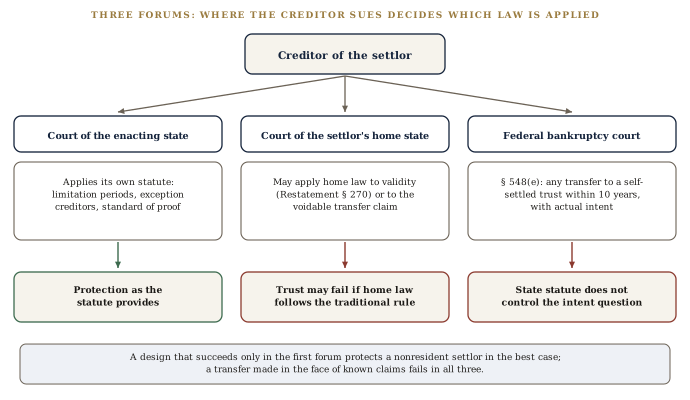
Three forums. A planner designing a self-settled trust should test the design against three forums. The first is a court of the enacting state, applying its own statute to a creditor who sues there; the statute will usually be applied as written. The second is a court of the settlor's home state, where most creditors sue, which may apply its own law to the validity of the trust or to the creditor's voidable transfer claim (see infra ¶ 3770). The third is a federal bankruptcy court, which may avoid any transfer to a self-settled trust made within ten years before the petition with actual intent to hinder, delay or defraud creditors, whatever the state statute provides (see infra ¶ 3780). A trust that would succeed only in the first forum offers limited protection to a settlor who lives elsewhere, and a trust funded at the wrong time will fail in all three.