

¶ 3001
Overview
Scope of the chapter. Part VII of this book turns from the architecture of the trust to the assets it holds. A modern trust rarely owns its most important assets directly. It owns shares in a corporation, units in a limited liability company, an interest in a limited partnership, or the single share of a company formed offshore to hold a portfolio. The trustee's real work is then done one step removed, through the governance of an entity whose own law, own managers and own creditors stand between the trust and the underlying property. This chapter examines that arrangement. It covers why trusts hold through entities, how the planner chooses among the available forms, the duties a trustee owes when it is also a member, manager, partner or director of the entity, the duty to supervise a company the trust controls and the clauses that relieve the trustee of it, the tension between retaining a family company and the duty to diversify, the flow of information and money between the entity and the trust, the transfer tax attacks on entities formed for estate planning, and the federal classification and reporting rules that follow the structure. Chapter 31 then takes up the special statutes that permit a trustee to hold a concentrated position without the duty to diversify, and chapter 32 the succession of a closely held operating business held in trust (see infra chs. 31, 32).
Terminology. The chapter uses entity for any corporation, partnership, limited liability company or other organization in which a trustee holds an interest. A holding entity is one formed to hold investment assets or other entities and conducts no business of its own. An underlying company is the term used in offshore practice for a company, usually incorporated in the same or a third jurisdiction, all of whose shares are held by the trustee and through which the trust's investments are made. A family limited partnership or family LLC is an entity formed by members of one family, typically with a parent or a trust as the principal contributor, often with the purpose or effect of producing valuation discounts for transfer tax purposes. An anti-Bartlett provision is a clause in a trust instrument that relieves the trustee of the duty, identified in Bartlett v. Barclays Bank Trust Co., to supervise the affairs of a company the trust controls (see infra ¶ 3060). The two-level problem is the chapter's shorthand for the question that runs through every section: which body of law governs a decision taken by a trustee who stands both inside the trust and inside the entity.
The two-level problem. A trustee who owns all of the units of an LLC and is also its sole manager makes each decision twice. As manager, it acts under the LLC's operating agreement and the LLC statute, which may permit it to act with the latitude of a business manager, protected by the business judgment rule or by a contractual standard. As trustee, it acts under the trust instrument and the trust code, which require it to administer the trust solely in the interests of the beneficiaries and to act as a prudent investor. Where the trust owns the whole entity, the two duties usually point the same way, because the interests of the entity's only owner and the interests of the trust's beneficiaries coincide. Where other persons own interests in the entity, or where the instrument assigns entity-level roles to family members who are not trustees, the duties can diverge. The Uniform Trust Code answers part of the question: in exercising control over an enterprise, "the trustee shall act in the best interests of the beneficiaries," and where the trust is the sole owner, the trustee "shall elect or appoint directors or other managers who will manage the corporation or enterprise in the best interests of the beneficiaries." Unif. Trust Code § 802(g) (amended 2010). The courts have answered the rest case by case, and the leading decisions do not all point the same way (see infra ¶ 3030).
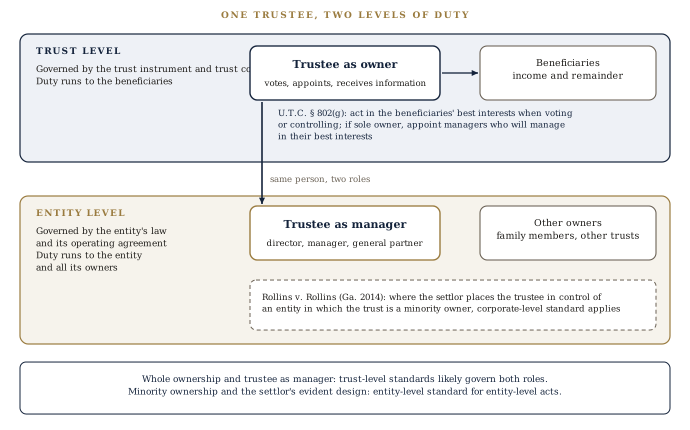
Why the problem matters now. Three developments have pushed the trust-owned entity from a specialist structure to the ordinary case. The first is the prudent investor rule and the directed-trust statutes, which encourage trustees to place difficult assets in separate vehicles with their own managers (see supra chs. 6–9). The second is the limited liability company, which gives a trustee a flexible, single-tier-taxed vehicle whose operating agreement can be drafted to fit the trust (see infra ¶ 3020). The third is the long-duration trust, which may hold a family business, a real estate portfolio or a collection for generations and needs a governance structure that will outlast any individual trustee (see supra ch. 22). Each development multiplies the occasions on which a trustee acts at two levels.
Plan of the chapter. Paragraph 3010 sets out the reasons for holding through entities. Paragraph 3020 compares the forms. Paragraph 3030 examines the trustee's duties at the entity level and discusses the Georgia Supreme Court's decision in Rollins v. Rollins. Paragraph 3040 states the duty to supervise a controlled company as Brightman J. formulated it in Bartlett. Paragraph 3050 examines retention and diversification. Paragraph 3060 examines underlying companies held by offshore trustees and the anti-Bartlett provisions that accompany them, through the Hong Kong Court of Final Appeal's decision in Zhang Hong Li v. DBS Bank (Hong Kong) Ltd. Paragraph 3070 examines information, accounting and distributions. Paragraph 3080 examines the estate tax attacks on family entities through Strangi, Bongard and Powell. Paragraph 3090 addresses federal classification, beneficial ownership reporting and drafting, and closes with model provisions and a checklist.