

¶ 2601
Overview
Scope of the chapter. A trust of any duration has beneficiaries who cannot speak for themselves. Some are minors. Some are incapacitated. Some are unborn, and some cannot yet be identified because the class that will take has not closed. Others can be found and are competent but have been kept from knowing about the trust by the settlor's direction. Every act in the life of the trust that needs the consent of the beneficiaries, or that becomes final only when they have had notice, raises the same question: who may receive the notice, give the consent or bring the claim for the beneficiary who cannot? The law answers with a doctrine of representation. This chapter examines that doctrine in full. It traces the equitable rule from which the modern statutes grew (¶ 2610), the constitutional limits that bound any rule allowing one person to bind another (¶ 2620), Article 3 of the Uniform Trust Code and the state variations on it (¶ 2630), and the conflict-of-interest rules on which representation most often fails (¶ 2640). It then turns to the designated representative, a person chosen by the settlor or under the instrument to act for one or more beneficiaries, comparing the statutes (¶ 2650) and examining the representative's duties, liability, selection and succession (¶ 2660). It closes with the uses of representation in practice (¶ 2670), court-appointed representatives and the position in the international jurisdictions (¶ 2680), and model provisions and a checklist (¶ 2690).
Relation to other chapters. Representation runs through the whole of Parts IV and VI of this book, and several earlier chapters apply it to particular transactions. Chapter 16 examined representation of nonconsenting and unborn beneficiaries in consent modification and termination, including the guardian ad litem in Hatch v. Riggs National Bank (see supra ¶ 1630). Chapter 19 examined the persons who must sign a nonjudicial settlement agreement and set out the categories of Article 3 as they apply to settlements (see supra ¶ 1920). Chapter 25 examines the silent trust, in which a designated representative receives the information that the beneficiary does not (see supra ch. 25). This chapter supplies the general doctrine those chapters assume. Where an earlier chapter has quoted a provision, this chapter refers to that treatment and concentrates on the questions the earlier chapter left open.
Four forms of representation. The statutes recognize four ways in which one person may stand for another in trust matters.
- Representation by a fiduciary or parent. A conservator, guardian, agent, trustee or personal representative may bind the person whose property or interests the fiduciary controls, and a parent may bind a minor or unborn child, in each case to the extent there is no conflict of interest. Unif. Trust Code § 303 (2000, amended 2010).
- Virtual representation. A person with "a substantially identical interest with respect to the particular question or dispute" may bind a minor, incapacitated or unborn person, or one who cannot be identified or located, if there is no conflict of interest. Id. § 304. The holder of a power of appointment may bind those whose interests are subject to the power, a rule that rests on the same idea. Id. § 302.
- Designated representation. A person named in the instrument, or appointed by someone the instrument authorizes, may bind one or more beneficiaries. The Uniform Trust Code has no such category. A growing number of states have added one, under various names and with widely varying limits (see infra ¶ 2650).
- Court-appointed representation. A court may appoint a representative or guardian ad litem for a person whose interest is unrepresented or inadequately represented. Id. § 305.
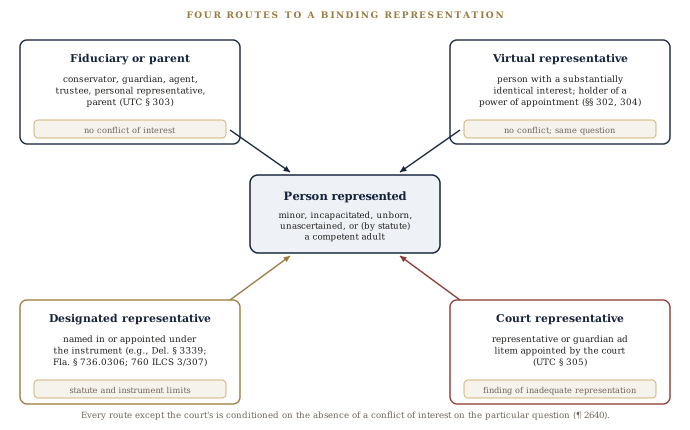
The first two forms are old. The third is recent, and most of the doctrinal questions in this chapter concern it. The fourth is the safety valve for the other three.
Why representation matters to design. Representation was once a procedural question, answered by the court in a proceeding and seldom considered by the drafter. Three developments have made it a design question. The first is the growth of nonjudicial procedure: nonjudicial settlement agreements, consent modification, decanting on notice, and the approval of accounts by release, all of which need someone to act for the beneficiary who cannot (see supra chs. 16, 17, 19). The second is the silent trust, in which the settlor's wish that a beneficiary not know of the trust must be reconciled with the trustee's accountability, and the designated representative is the statutory device for that reconciliation (see supra ch. 25). The third is the long-term trust. A trust that will last for generations will spend most of its life with beneficiaries who are not yet born, and the rules that decide who speaks for them decide whether the trust can be administered, modified and settled without repeated resort to a court (see supra ch. 22). A planner who leaves representation to the default rules leaves those questions to a statute the settlor did not choose and that may change before the questions arise.
Terminology. This chapter uses "representative" for any person who may bind another under a representation statute, "person represented" for the person bound, and "designated representative" for a representative chosen by or under the instrument, whatever name the governing statute uses. Delaware, Florida and Illinois use "designated representative." Del. Code Ann. tit. 12, § 3339(a); Fla. Stat. § 736.0306; 760 Ill. Comp. Stat. 3/307. South Dakota uses "representative" for every person who may bind another and recognizes persons "designated in the governing instrument" as one class of representative. S.D. Codified Laws §§ 55-18-1(19), 55-18-9(11). "Virtual representation" means representation by a person with a substantially identical or substantially similar interest. The phrase is old and is used by courts and commentators more often than by the statutes themselves, though Nevada, in its statute on arbitration of trust disputes, applies "the common law relating to the doctrine of virtual representation." Nev. Rev. Stat. § 164.930(3).