
¶ 1201
Overview
Scope of the chapter. A protector is defined by its powers. The statutes that recognize the office say little about what a protector is and a great deal about what a protector may do, and the instruments that create the office are drafted in the same way: as a list of powers, each conferred, limited or withheld by the terms of the trust. Chapter 11 traced the office from its offshore origins to its statutory recognition in the United States (see supra ch. 11). This chapter takes the powers one at a time. It sets out the statutory catalogues (¶ 1210), then examines the power to remove and replace trustees (¶ 1220), the power to amend administrative and dispositive terms (¶ 1230), veto and consent powers (¶ 1240), the power to change situs and governing law (¶ 1250), the powers to add and remove beneficiaries and to terminate the trust (¶ 1260), and the powers to interpret the instrument, correct drafting errors and resolve disputes (¶ 1270). It closes with the tax consequences of the catalogue as a whole (¶ 1280) and with the creditor consequences and drafting of protector provisions (¶ 1290). The duties that attach to these powers are the subject of chapter 13, and the succession, removal and deadlock of protectors the subject of chapter 14 (see infra chs. 13, 14).
Three questions for every power. Each power in a protector clause should be tested against three questions before it is drafted. The first is a question of trust law: what may the holder do, by what procedure, within what limits, and with what effect on the trustee and the beneficiaries? The second is a question of tax law: does the power, in the hands of this holder, cause the trust to be treated as owned by the grantor or another person for income tax purposes, or cause the trust property to be included in the gross estate of the settlor or of the holder? The third is a question of creditor law: can a creditor of the settlor or of a beneficiary use the power, or the holder's relationship to the debtor, to reach the trust property or to compel the holder to act? A power that answers the first question well may answer the second or third badly. The power to add beneficiaries is the clearest instance: it gives the trust the flexibility the settlor wants, it makes the trust a grantor trust under section 674 (see infra ¶ 1280.04), and in the hands of a settlor it supports the argument that the settlor retains control (see infra ¶ 1290.02).
Powers and labels. The word "protector" carries no fixed content. South Dakota defines a trust protector as "any person whose appointment as protector is provided for in the instrument," a definition that the reporter and chair of the uniform act's drafting committee have called circular. S.D. Codified Laws § 55-1B-1(2); John D. Morley & Robert H. Sitkoff, Making Directed Trusts Work: The Uniform Directed Trust Act, 44 ACTEC L.J. 3 (2019) (draft of Sept. 28, 2018, at 10 n.37). Nevada's definition is the same. Nev. Rev. Stat. § 163.5547. The Uniform Directed Trust Act abandons the label altogether and speaks of trust directors holding powers of direction. Unif. Directed Trust Act § 2(5) (2017). What a court will examine, under any of these regimes, is the particular power, the identity of its holder and the terms on which it was granted. The drafter's task is therefore to choose powers and to state for each power who holds it, when it may be exercised, by what procedure, subject to what limits and in what capacity.
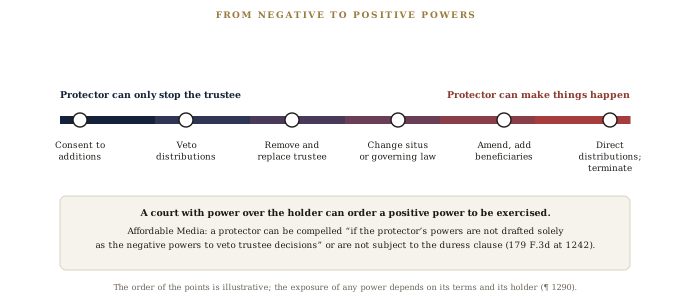
Positive and negative powers. A distinction that runs through the chapter, and through the cases, is between powers that allow the protector to initiate action and powers that allow the protector only to prevent it. The Uniform Trust Code's comment drew the line in terms of trustee responsibility: "A power to direct involves action initiated and within the control of a third party," while under a veto power "the trustee is responsible for initiating the decision, subject to the third party's approval." Unif. Trust Code § 808 cmt. (2010). The distinction matters for creditors as well. The Ninth Circuit observed that a protector "can be compelled to exercise control over a trust to repatriate assets if the protector's powers are not drafted solely as the negative powers to veto trustee decisions." FTC v. Affordable Media, LLC, 179 F.3d 1228, 1242 (9th Cir. 1999). A positive power is a lever that a court with jurisdiction over the holder can order the holder to pull. A negative power is harder to turn into an affirmative act, though not impossible (see infra ¶ 1290.04).