

¶ 1001
Overview
The question. A directed trust divides a function that the law of trusts traditionally kept in one pair of hands. The trustee holds title and executes; another person, whether called an adviser, a protector, a trust director or an investment committee, decides. When a decision goes wrong, the beneficiaries look for someone to answer for the loss. This chapter asks who that is. It examines the standards by which the directed trustee is judged for carrying out a direction, the standards by which the person who gave the direction is judged for giving it, and the procedural rules (limitation, jurisdiction, privilege and release) that decide whether either can be reached at all. The substantive grants of power and the statutes that authorize them are treated in the three chapters before this one. See supra chs. 6–9. This chapter is about the consequences when a power is used badly.
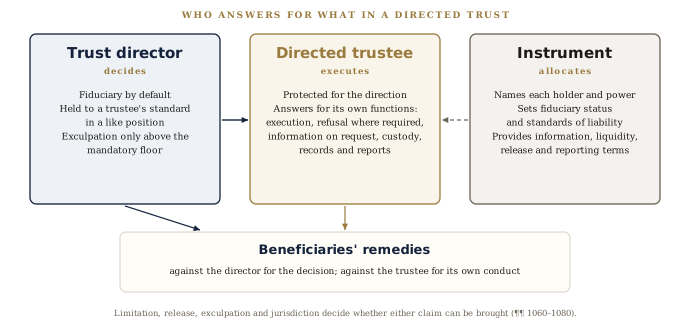
Three questions. Every claim arising out of a directed trust resolves into three questions. The first is whether the directed trustee is liable for complying with a direction, or for failing to do something that compliance did not require, such as warning the beneficiaries or questioning the direction. The second is whether the trust director is liable for the direction, and if so by what standard: that of a trustee, that of a nonfiduciary, or some intermediate standard that the instrument sets. The third is whether a claim against either of them is barred, because a limitation period has run, because a beneficiary released it, because an exculpatory clause covers it, or because the court in which the beneficiary sues has no jurisdiction over the defendant. The statutes answer the first question with some uniformity, the second with less, and the third almost entirely by borrowing the rules that apply to trustees.
The thin record. The reported cases are few, and the commentators continue to cite the same three or four. Richard W. Nenno, Directed Trusts: Making Them Work, 45 Tax Mgmt. Est., Gifts & Tr. J. 05, pt. VI.A (Sept. 2, 2020) ("only two courts have decided whether a directed-trust statute afforded protection to a directed trustee"). There are several reasons. Most directed trusts are administered by corporate trustees that settle disputes before trial. Many directions are given by family members who will not be sued by other family members. And the statutes in the leading jurisdictions are drafted to leave a beneficiary little to plead against the trustee. The cases that do exist are therefore read closely, and a single trial-court ruling, such as the Virginia decision discussed at ¶ 1030, has driven legislation in a dozen states.
The shape of the answers. Three liability models appear in the statutes. Under the first, the directed trustee is not liable for following a direction at all, and the instrument and the director bear the whole risk. Nevada, Wyoming, Alaska and South Dakota take this approach, with variations. Under the second, the trustee is liable only for its own wilful misconduct in complying. Delaware pioneered this model and the Uniform Directed Trust Act adopts it. Under the third, the trustee must refuse a direction that it knows would be a serious breach of the director's fiduciary duty or that is manifestly contrary to the terms of the trust. That was the rule of Uniform Trust Code § 808(b) as promulgated in 2000. It remains the law in Code states that did not later adopt the Uniform Directed Trust Act. See infra ¶ 1020. The director, for its part, is presumptively a fiduciary under all three models, and the standard to which it is held is ordinarily that of a trustee in a like position, subject to what the instrument says. See infra ¶ 1050.
The record-keeping lesson. Two of the cases in this chapter turn less on doctrine than on paper. In the Delaware Mennen litigation, the court presumed that an adviser who could produce no record of his diligence had done none. See infra ¶ 1050.04. In the federal Cassity litigation, the trustee's statutory defense failed because the statute required the trust assets to stay within the bounds of prudence, and the court held the trustee liable unless it had ensured that they did. See infra ¶ 1030.03. A practitioner who takes one point from the case law should take this one: the allocation of liability that the instrument and the statute make is only as good as the record that proves each party stayed within its role.
Plan of the chapter. Paragraph 1010 states the common-law and Uniform Trust Code baseline. Paragraph 1020 compares the statutory standards, with Table 10-1, and examines the meaning of wilful misconduct. Paragraph 1030 discusses the directed-trustee cases. Paragraph 1040 examines the duties a directed trustee keeps: to warn, to monitor, to inform, to refuse and to seek instructions. Paragraph 1050 turns to the liability of trust directors, advisers and protectors, with the Mennen case. Paragraphs 1060 through 1080 treat exculpation and release, limitation and repose, and jurisdiction and privilege. Paragraph 1090 closes with drafting.