

¶ 5601
Overview
Purpose of the chapter. The preceding chapters examine the law of the limited liability company subject by subject. This chapter brings that law to bear on a single document, the operating agreement, and follows the order in which a complete agreement is usually arranged. For each article it states the purpose of the provisions, the statutory default that applies if the agreement is silent, the choices open to the drafter and their consequences, and the chapter of this treatise in which the substance is examined. Most articles close with a model provision. The model provisions are illustrations of one set of choices for a particular kind of LLC. They are drafted for a Delaware LLC unless the text states otherwise, and each must be adapted to the governing statute, the tax classification of the LLC and the bargain among its members.
Why the order of the agreement matters. An operating agreement is read as a whole, and its provisions interact. The definition of "Capital Account" controls the liquidation waterfall; the waterfall controls the tax allocations; the transfer article controls who may vote; and the amendment article controls whether any of these may later be changed without a particular member's consent. A drafter who works through the agreement in order is more likely to see these connections than one who assembles it from clauses taken from different forms. The structure of a complete agreement, and the reasons for it, are examined in chapter 7 (see supra ¶ 790), and the risks of the short-form agreement that leaves most matters to the statute are examined at supra ¶ 750.
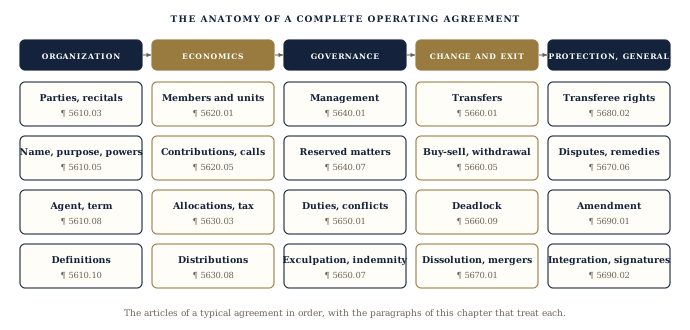
The two reference statutes. The chapter states the defaults of two statutes. The first is the Delaware Limited Liability Company Act, which governs a large share of LLCs formed for investment, financing and joint venture purposes and whose policy is "to give the maximum effect to the principle of freedom of contract and to the enforceability of limited liability company agreements." Del. Code Ann. tit. 6, § 18-1101(b). The second is the Revised Uniform Limited Liability Company Act, cited in this chapter as the uniform act, which supplies more defaults and imposes more limits on the agreement. Unif. Ltd. Liab. Co. Act § 105(c)–(e) (2013). Where another state's statute departs from both in a way that matters to drafting, the text says so. The reasons for identifying the reference statute at the outset are examined at supra ¶ 290.
What the agreement may and may not do. In Delaware, the agreement may expand, restrict or eliminate fiduciary duties, but "may not eliminate the implied contractual covenant of good faith and fair dealing," and it may limit or eliminate liabilities except for "a bad faith violation" of that covenant. Del. Code Ann. tit. 6, § 18-1101(c), (e). The uniform act lists fifteen matters the agreement may not vary, among them the law governing the LLC, the obligation of good faith and fair dealing, the right to information under § 410 beyond reasonable restrictions, the judicial grounds for dissolution in § 701(a)(4), and the rights of persons other than members and managers. Unif. Ltd. Liab. Co. Act § 105(c) (2013). It permits the agreement to alter or eliminate aspects of the duty of loyalty and to alter the duty of care only "[i]f not manifestly unreasonable," a standard the court applies as of the time the term was adopted. Id. § 105(d)(3), (e). These limits are examined in chapter 3 (see supra ¶¶ 320, 330) and form the outer boundary of every drafting choice described below.
Method. Each article is treated in the same way:
- Purpose. What the provisions are for and what goes wrong without them.
- Default. The Delaware and uniform-act rule that applies if the agreement is silent, with the section cited.
- Choices. The principal alternatives and their consequences, including consequences for tax classification, financing and creditor protection.
- Model provision. A short provision illustrating one choice. Bracketed words such as "[number]" or "[name]" mark terms to be completed.
- Cross-reference. The chapter and paragraph in which the law is examined.
Organization. The chapter proceeds in nine further parts:
- the drafting process and the preliminary articles, including definitions (¶ 5610);
- members, units, admission and capital (¶ 5620);
- allocations, tax provisions and distributions (¶ 5630);
- management, voting and information (¶ 5640);
- duties, conflicts, exculpation and indemnification (¶ 5650);
- transfers, exit and deadlock (¶ 5660);
- dissolution, entity transactions, disputes and remedies (¶ 5670);
- creditor-protection provisions and variations for particular kinds of LLC (¶ 5680); and
- general provisions, a summary table and a pre-signing checklist (¶ 5690).
Defined terms used in the model provisions. The model provisions assume an agreement that defines the following terms: "Act" (the governing LLC statute); "Agreement"; "Board" (where the LLC has a board of managers); "Capital Account"; "Code" (the Internal Revenue Code of 1986, as amended); "Company"; "Manager"; "Member"; "Percentage Interest"; "Transfer"; "Treasury Regulations"; and "Units." Where a model provision uses another defined term, the provision itself states what the term means or the text identifies where the definition belongs.
A note on forms. Model operating agreements appear in Appendix C. A form is a starting point. The provisions of a form reflect choices made for a particular kind of transaction, and many of the disputes examined in chapters 21 through 38 arose from provisions carried into an agreement from a form without attention to whether they suited the parties. The courts construe the agreement as written, and a provision that does not match the parties' bargain will be enforced according to its terms. See supra ¶ 760.