

¶ 5501
Overview
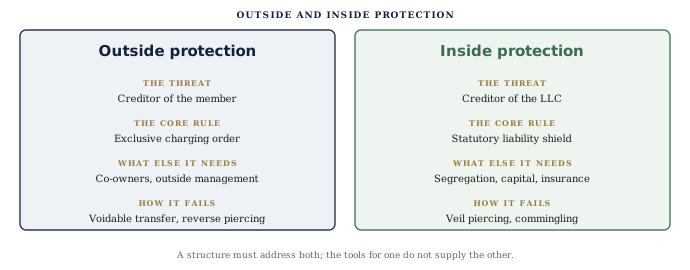
Scope of the chapter. The LLC is the most widely used entity in American asset protection planning. It serves two distinct purposes, which this chapter treats separately. The first is to protect the member's wealth from the member's own creditors, so that a judgment against the member does not reach the assets the member holds through the LLC. The second is to protect the LLC's assets from the LLC's creditors, so that a liability arising in one business or from one property does not reach the assets of other businesses or properties, or the member's personal wealth. The first is often called outside protection, because the threat comes from a creditor outside the entity. The second is called inside protection, because the threat arises from the entity's own activities. The two require different tools, fail in different ways and depend on different bodies of law.
Relation to the companion treatise. This chapter applies to LLCs the principles developed at greater length in the companion volume, Lighthouse on Asset Protection (2026). That treatise examines the law of voidable transfers (chs. 6–7), bankruptcy (ch. 8), entities and charging orders (chs. 15–16), and the asset protection laws of the Cook Islands (ch. 22), Nevis (ch. 23), Belize (ch. 24), Wyoming (ch. 26) and Delaware (ch. 27). The reader planning a structure that depends on any of those subjects should consult the fuller treatment there. This chapter concentrates on the LLC: what its statutes protect, where the protection ends, and the effect of the choice of formation jurisdiction and the design of the operating agreement on the result.
The two problems compared. Outside protection rests on the charging order: the rule that a creditor of a member may reach only the distributions the member would receive, and may not seize the member's interest or the LLC's property. Its strength depends on the statute of the formation state, on whether the LLC has more than one member, on the forum in which the creditor sues and on whether the transfer of assets into the LLC can be attacked. Inside protection rests on the liability shield: the rule that members and managers are not liable for the LLC's debts solely by reason of their status. Its strength depends on the separation of the LLC from its members and from other entities, on capitalization, on insurance and on the veil-piercing law of the court that hears the creditor's claim. A structure that serves one purpose may weaken the other. A single LLC holding all of a family's assets may give adequate outside protection under a strong charging-order statute while exposing every asset to the liabilities of any one of them.
Timing. No LLC structure protects assets transferred to it to hinder, delay or defraud an existing creditor. The law of voidable transfers applies to transfers into an LLC as it applies to any other transfer, and a court that finds a transfer voidable may reach the transferred assets in the LLC's hands or award judgment against the LLC. Planning is effective when it is done before claims arise, for legitimate business and family purposes, and while the member remains solvent. See Lighthouse on Asset Protection chs. 5–7 (2026).
Organization. The chapter proceeds in nine parts:
- the charging order as the core of outside protection (¶ 5510);
- the limits on outside protection (¶ 5520);
- structuring the LLC for outside protection (¶ 5530);
- protecting the LLC's assets from its own creditors (¶ 5540);
- segregation of assets among entities (¶ 5550);
- Delaware LLCs and the Court of Chancery (¶ 5560);
- the LLC statutes of Nevis, Belize and the Cook Islands (¶ 5570);
- a planning matrix (¶ 5580); and
- a checklist (¶ 5590).