

¶ 5201
Overview
Scope of the chapter. This chapter examines three settings in which the LLC serves as the vehicle for capital that comes from more than one source or is deployed through more than one entity: the joint venture between operating companies, the private investment fund and its surrounding entities, and the holding structure in which one LLC owns and controls others. Each setting raises questions that the general chapters of this treatise address in the abstract. The joint venture tests the rules on management by designated representatives, on the modification of fiduciary duties and on restrictive covenants. The private fund tests the rules on economic arrangements among investors and sponsors and draws in federal securities, tax and pension regulation. The holding structure tests the liability shield, because the separateness of each entity in a group is the premise on which the structure rests. The chapter treats these questions as they arise in practice and refers to the general chapters for the underlying doctrine.
Why the LLC is used. Three features of the LLC account for its use in these settings. First, the operating agreement can allocate management, economic rights and exit rights with nearly complete freedom, so that two corporate parents can build a governance structure that reflects their bargain without the constraints of a corporate statute. Del. Code Ann. tit. 6, § 18-1101(b). Second, an LLC with two or more members is classified as a partnership for federal income tax purposes unless it elects otherwise, so that the venture's income and losses pass through to its owners and each owner can use them against its own tax position. Chapter 39 treats classification, and Chapters 40 and 41 treat the partnership rules. Third, the LLC Act permits the parties to restrict or eliminate the fiduciary duties that members and managers would otherwise owe, which allows each parent to pursue its own business outside the venture and allows the individuals it appoints to the venture's board to act with its interests in view. Del. Code Ann. tit. 6, § 18-1101(c). The limits on that freedom are treated in Chapters 3 and 22 and, for the venture setting, in ¶ 5230.
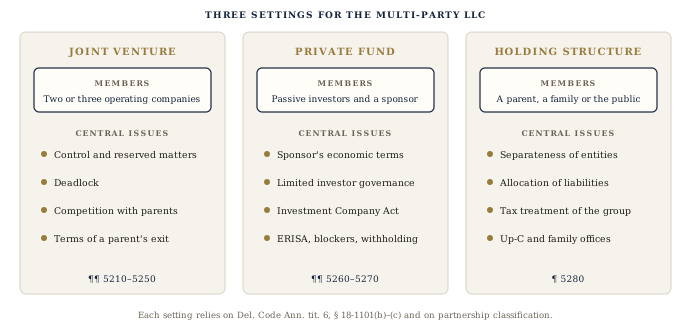
The three settings compared. The settings differ in who the members are and in what they want from the entity. In a joint venture the members are usually two or three operating companies of comparable sophistication, each contributing assets, technology or market access, and each intending to remain a participant in the business for a period of years. The central issues are control, deadlock, competition between the venture and its parents, and the terms on which a parent may leave. In a private fund the members are passive investors who commit capital to a sponsor's judgment for a fixed term. The central issues are the sponsor's economic terms, the investors' limited governance rights and the federal regulation of pooled investment. In a holding structure the members are often a single parent or a family, and the central issues are the separateness of the entities, the allocation of liabilities among them and the tax treatment of the group. Figure 52.1 sets out the three settings.
Relationship to other chapters. The chapter builds on several earlier treatments and does not repeat them. The economic waterfall and preferred returns used in funds and ventures are treated in Chapter 16; boards and officers in Chapter 19; the default fiduciary duties and their modification in Chapters 21 and 22; conflicts of interest in Chapter 24; veil piercing within corporate groups in Chapter 26; buy-sell, drag-along and tag-along provisions in Chapter 30; deadlock in Chapter 32; forum selection in Chapter 37; partnership taxation in Chapters 40 and 41; the centralized partnership audit regime in Chapter 44; foreign members and withholding in Chapter 46; and the Investment Company Act and the Investment Advisers Act in Chapter 47. Where a question arises here that one of those chapters answers, the text states the conclusion and gives the cross-reference.
Delaware as the usual jurisdiction. Most joint venture LLCs between large companies, most fund-related LLCs and many holding company LLCs are formed in Delaware. The reasons are the breadth of section 18-1101, the volume of decided cases construing the LLC Act and the specialized jurisdiction of the Court of Chancery. Chapter 5 sets out the choice of jurisdiction, including the developments since 2024 that have led some sponsors and companies to consider Texas or Nevada, and ¶ 540 states the facts on the Court of Chancery as a forum. The cases discussed in this chapter are drawn principally from Delaware because the Delaware courts have decided most of the reported disputes over venture and fund LLC agreements. Their holdings rest on contract interpretation and on the statute's policy of freedom of contract, and courts in other states applying their own LLC acts often reach similar results.
A note on terminology. The chapter uses "venture" for the jointly owned LLC and "parent" for each member that is itself an operating company. It uses "designated manager" for an individual who sits on the venture's board of managers by appointment of one parent. In the fund setting it uses "sponsor" for the firm that organizes and manages the fund, "general partner" or "managing member" for the entity through which the sponsor controls the fund, and "management company" for the entity that employs the investment professionals and receives the management fee. It uses "holdco" for an LLC whose principal assets are its interests in subsidiaries.