

¶ 4501
Overview
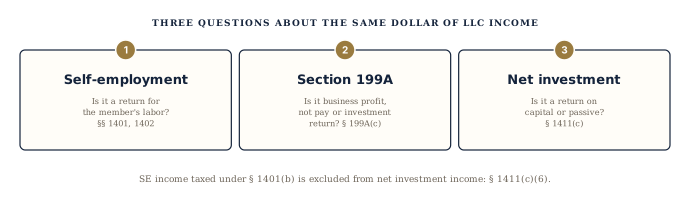
Scope of the chapter. This chapter examines three federal regimes that turn on the character of a member's income from an LLC taxed as a partnership or disregarded as an entity separate from its owner: the self-employment tax imposed by chapter 2 of the Internal Revenue Code, the deduction for qualified business income under § 199A, and the net investment income tax under § 1411. Each regime asks a different question about the same dollar of LLC income. The self-employment tax asks whether the income is a return for the member's labor in a trade or business. Section 199A asks whether the income is business profit, as distinct from compensation or investment return. The net investment income tax asks whether the income is a return on capital or arises from a business in which the member does not materially participate. The answers determine whether a member pays self-employment tax at a combined rate of up to 15.3%, the 3.8% net investment income tax, both or neither, and whether 20% of the income is deductible.
Why the LLC form matters. For a corporation the lines are drawn by status. Wages paid to an employee-shareholder bear employment taxes, and dividends do not. For a partnership the lines are drawn by statute and by the partner's role. A general partner's distributive share of trade or business income is self-employment income, and a limited partner's distributive share, other than guaranteed payments for services, is excluded. I.R.C. § 1402(a)(13). The LLC fits neither category. Its members enjoy the limited liability that once marked the limited partner. They may also manage the business as fully as a general partner. The Code has never been amended to say where an LLC member falls, and the Treasury has never finalized regulations that do so. The courts have answered the question piecemeal, and in 2026 two courts of appeals adopted readings of § 1402(a)(13) that differ in emphasis and in method. See ¶ 4530.
The relationship among the three regimes. The regimes interlock. Income that is self-employment income subject to the Medicare portion of the self-employment tax is excluded from net investment income. I.R.C. § 1411(c)(6); Treas. Reg. § 1.1411-9(a). Income from a business in which the member materially participates is outside the net investment income tax, whether or not it is self-employment income. I.R.C. § 1411(c)(2)(A). Guaranteed payments for services are self-employment income for every member and are excluded from qualified business income. I.R.C. §§ 199A(c)(4)(B), 1402(a)(13). The result is that the choice among guaranteed payments, preferred allocations and residual distributive shares, and the allocation of management authority in the operating agreement, can move income among the three regimes. The interaction is examined in ¶ 4580 and summarized in Table 45-3.
Relation to other chapters. Classification of the LLC is discussed in Chapter 39, partnership allocations and guaranteed payments in Chapter 40, disregarded entities in Chapter 42, and the S corporation election, which converts part of an owner's return into wages and part into distributions that bear no employment tax, in Chapter 43. State taxes, including state treatment of § 199A, are discussed in Chapter 46. This chapter cross-refers to those chapters and does not repeat them.
Figures used in this chapter. Dollar thresholds are stated for 2026 where the statute indexes them. The 2026 Social Security contribution and benefit base is $184,500. 90 Fed. Reg. (Nov. 3, 2025) (Soc. Sec. Admin. notice, FR Doc. 2025-19763). The 2026 § 199A threshold and phase-in amounts appear in Rev. Proc. 2025-32, § 4.26, and are reproduced in Table 45-2. The thresholds for the additional Medicare tax and the net investment income tax are fixed by statute and are not indexed. I.R.C. §§ 1401(b)(2), 1411(b).