

¶ 4101
Overview
Scope of the chapter. Chapter 40 examined how an LLC taxed as a partnership is formed, how its members acquire and adjust the basis of their interests, and the rules for allocating its income and loss among them. This chapter follows the same interests to the point at which value leaves the company or changes hands. It covers distributions made while a member remains in the company, distributions that liquidate a member's interest, payments to members who retire or die, sales and other transfers of interests, the adjustments to the basis of company property that those events may produce, the death of a member, the termination of the company for tax purposes, and the rules that apply when the member who departs or sells is a foreign person. Chapter 39 addresses whether the LLC is a partnership in the first place, and Chapter 42 addresses the single-member LLC that is disregarded. Throughout this chapter, "partnership" means an LLC classified as a partnership for federal income tax purposes, and "partner" means a member or a transferee who is treated as a partner. The Code uses those words, and the chapter follows it.
Two competing models. Subchapter K treats a partnership sometimes as an entity separate from its partners and sometimes as an aggregate of them. The distribution rules are largely entity rules. A distribution of cash or property generally produces no gain or loss to the partnership or to the partner, and the partner takes the property with a basis drawn from the partnership's basis or from the partner's own outside basis. I.R.C. §§ 731(a)–(b), 732. The transfer rules start from the entity model as well: a sale of an interest is treated as the sale of a single capital asset. I.R.C. § 741. The aggregate model then intrudes wherever the entity treatment would let a partner convert ordinary income into capital gain, shift built-in gain to another partner, or exit without tax. Section 751 looks through the interest to the partnership's ordinary-income assets. Sections 704(c)(1)(B) and 737 look back to property a partner contributed within the preceding seven years. Section 864(c)(8) looks through the interest to the partnership's United States business. Much of the practical difficulty of this area comes from deciding which model governs a given transaction and how the two interact.
Inside and outside basis. Every rule in this chapter turns on two numbers. Outside basis is a member's basis in the LLC interest, determined under §§ 705, 722 and 742 and adjusted by the member's share of LLC liabilities under § 752 (see supra Chapter 40). Inside basis is the LLC's basis in each of its assets. When the company is formed, the two usually match in the aggregate. They diverge as interests are bought at prices that reflect appreciation the company has not recognized, as members die, and as the company distributes property whose basis differs from the distributee's outside basis. The distribution and transfer rules are designed to preserve the total gain or loss inherent in the two sets of numbers, deferring it where possible, and the optional and mandatory basis adjustments of §§ 734(b) and 743(b) are the means by which the inside numbers are brought back into line with the outside numbers.
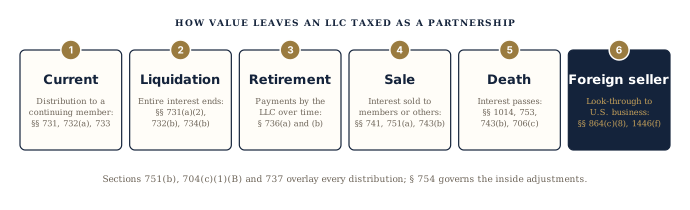
The transactions covered. A member can leave an LLC, or reduce an interest, in four principal ways: by receiving a current distribution while remaining a member, by having the LLC redeem the interest in liquidation, by selling the interest to another member or an outsider, or by dying. A fifth event, the termination of the company itself, ends every member's interest at once. The Code assigns different rules to each, and the choice among them is often within the parties' control. The same economic result, a departing member who receives $1 million for a 25% interest, may be taxed very differently depending on whether the LLC pays the money or the remaining members do. Figure 41.1 maps the principal transactions to the Code sections that govern them.
The role of the operating agreement. The tax rules do not depend on the label the parties attach to a transaction, but the form the parties choose and document carries great weight. Foxman v. Commissioner, 41 T.C. 535 (1964), aff'd, 352 F.2d 466 (3d Cir. 1965), held that an agreement framed with precision as a sale of a departing partner's interest to the continuing partners was a sale under § 741, even though the partnership itself made the payments, and rejected the continuing partners' later attempt to recast it as a liquidation under § 736. The buy-sell provisions examined in Chapter 30, the withdrawal and dissociation provisions examined in Chapter 31, and the liquidation provisions examined in Chapter 33 therefore have tax consequences that should be settled when they are drafted. This chapter notes those consequences at the points where they arise.
Organization. Paragraphs 4110 through 4150 address distributions: current distributions (¶ 4110), the basis of distributed property (¶ 4120), disproportionate distributions of ordinary-income assets (¶ 4130), the anti-mixing-bowl rules (¶ 4140), and liquidating distributions with the basis adjustments they may require (¶ 4150). Paragraph 4160 addresses payments to retiring and deceased members under § 736 and compares a redemption with a cross-purchase. Paragraph 4170 addresses sales and exchanges of interests. Paragraph 4180 addresses the death of a member, the termination of the company, conversions, and the tax position of a charging creditor. Paragraph 4190 addresses foreign transferors and withholding and closes with planning points and a checklist.