

¶ 2401
Overview
Scope of the chapter. A conflict of interest arises when a person who controls or influences a decision of the LLC has a personal stake in the outcome that differs from the LLC's. Conflicts are a normal feature of LLC practice. The LLC form is chosen for joint ventures between companies that also compete, for investment vehicles managed by sponsors that earn fees and manage other funds, for family businesses in which members lend to and lease property to the company, and for operating businesses in which the manager's affiliates supply services. This chapter examines how the statutes and the courts treat those conflicts, how operating agreements manage them, and what remedies are available when the process fails. It complements the treatment of fiduciary duties in chapters 21 and 22 and of conflicts committees and independent managers in chapter 19.
The central question. The law does not forbid conflicted transactions. Members and managers of an LLC may deal with the company, and the Delaware act says so expressly. Del. Code Ann. tit. 6, § 18-107. The question in every case is what standard governs the transaction and who bears the burden of showing that the standard was met. Where default fiduciary duties apply, a self-interested transaction by a manager or controller is reviewed for entire fairness unless a cleansing process was used. Where the agreement eliminates duties and substitutes a contractual standard, the agreement's standard governs, and the implied covenant polices the process by which the standard was satisfied. The answer depends on the agreement, the statute and the identity of the conflicted person.
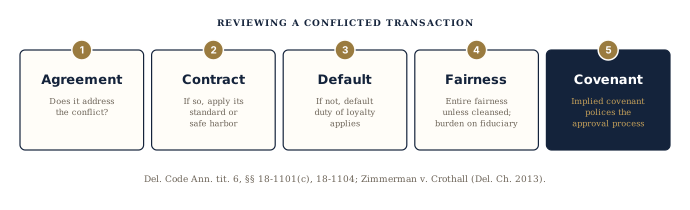
Organization. The chapter proceeds in nine parts:
- the forms of conflict (¶ 2410);
- the statutory framework (¶ 2420);
- the default standard of review (¶ 2430);
- contractual conflict procedures (¶ 2440);
- business opportunities and competition (¶ 2450);
- disclosure (¶ 2460);
- particular settings (¶ 2470);
- remedies (¶ 2480); and
- tax and accounting treatment, and a method for managing conflicts (¶ 2490).