

¶ 2301
Overview
Three protections. A person who agrees to manage an LLC, or to serve it as an officer or director, takes on exposure to claims by the LLC, by its members and by third parties. Three contractual devices allocate the cost of that exposure. Exculpation eliminates or limits the person's liability to the LLC and its members for damages. Indemnification shifts to the LLC the cost of liabilities and expenses the person incurs because of the service. Advancement requires the LLC to pay the person's defense costs as they are incurred, before the outcome of the proceeding is known, subject to repayment if the person is later found not entitled to indemnification. Insurance, the fourth element of the package, transfers part of the same risk to a third party. Each device operates differently, and an agreement that uses one does not thereby grant the others.
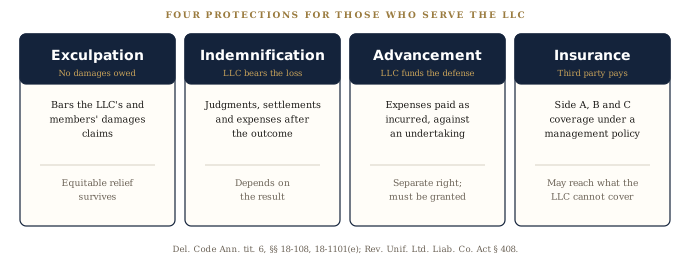
Why the LLC setting differs. In a Delaware corporation, all three devices are framed by statute: exculpation by § 102(b)(7) of the General Corporation Law, and indemnification, advancement and insurance by § 145. The Delaware LLC act contains no comparable regime. It permits the agreement to limit or eliminate liability, with a single exception for bad faith violations of the implied covenant. It also permits the LLC to indemnify "any member or manager or other person from and against any and all claims and demands whatsoever," subject only to the standards the agreement sets. Del. Code Ann. tit. 6, §§ 18-108, 18-1101(e). The drafter of an LLC agreement therefore writes the indemnification regime itself, since there is no statutory regime to adopt, and the courts construe what the drafter wrote as a contract. The uniform act takes a middle course. It supplies default rules on reimbursement, indemnification, advancement and insurance in § 408 and permits the agreement to vary them within the limits of § 105. Rev. Unif. Ltd. Liab. Co. Act §§ 105(c)(7), 408 (2013).
Relation to other chapters. Chapter 3 introduced exculpation as one of four techniques for reducing fiduciary exposure (see supra ¶ 340.07). Chapter 19 compared officer exculpation in corporations and LLCs. Fiduciary duties themselves are examined in chapters 21 and 22, and conflict transactions in chapter 24. This chapter examines the three devices in detail and closes with drafting guidance.
Organization. The chapter proceeds in nine parts:
- the statutory basis for exculpation (¶ 2310);
- the construction of exculpation clauses (¶ 2320);
- the statutory frameworks for indemnification (¶ 2330);
- the scope and conditions of indemnification (¶ 2340);
- advancement (¶ 2350);
- enforcement, fees on fees and multiple sources of indemnity (¶ 2360);
- insurance (¶ 2370);
- public policy limits and the relation to asset protection (¶ 2380); and
- drafting (¶ 2390).