

¶ 1701
Overview
Scope of the chapter. Every LLC statute permits the members to manage the company themselves or to place management in one or more managers. This chapter examines that choice. It describes the default rules of the Delaware act and the uniform act for each structure, the selection, tenure, removal and resignation of managers, the rights that members keep when they appoint managers, the special position of entity managers and the persons who control them, the delegation of management authority, and the legal consequences that follow from the choice of structure. It closes with guidance on choosing a structure, changing it and drafting the provisions that implement it.
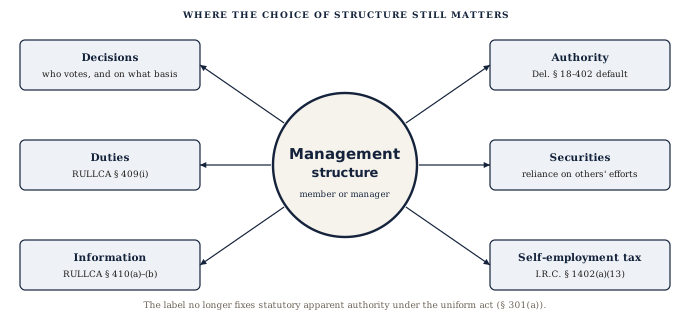
Why the label matters less than it once did. Under the first generation of LLC statutes, the choice between member management and manager management did a great deal of work. It was usually recorded in the articles of organization, it determined which persons had statutory power to bind the company, and for a time it bore on the classification of the LLC for federal tax purposes (see supra ch. 1). The modern statutes have reduced the work the label does. The uniform act provides that a member is not an agent of the company solely by reason of being a member, so that the structure no longer determines statutory apparent authority. Rev. Unif. Ltd. Liab. Co. Act § 301(a) (2013). The Delaware act lets the agreement allocate management in any way the members choose and states the default allocation only for agreements that are silent. Del. Code Ann. tit. 6, § 18-402. What remains is a set of default rules governing decision-making, duties and information, each of which the operating agreement may vary.
Why the label still matters. Three consequences of the structure survive the modern reforms. First, the default allocation of decision-making power differs, and many agreements rely on the default without saying so. Second, under the uniform act the structure determines who owes fiduciary duties and who has the stronger information rights. Rev. Unif. Ltd. Liab. Co. Act §§ 409(i), 410(a)–(b) (2013). Third, the structure bears on questions decided under other law, including whether an interest in the LLC is a security and whether a member's share of income is subject to self-employment tax. Each of these consequences is examined in ¶ 1770.
Organization. The chapter proceeds in nine parts:
- the two structures and their statutory defaults (¶ 1710);
- member management in practice (¶ 1720);
- managers: selection, tenure, removal and resignation (¶ 1730);
- rights reserved to members in a manager-managed LLC (¶ 1740);
- entity managers and the persons who control them (¶ 1750);
- delegation and management agreements (¶ 1760);
- the consequences of the choice of structure (¶ 1770);
- choosing and changing the structure (¶ 1780); and
- a drafting checklist (¶ 1790).
Related chapters. The agency questions raised by each structure are examined infra ch. 18, boards of managers and officers infra ch. 19, voting procedure and information rights infra ch. 20, and the fiduciary duties of members and managers infra chs. 21 and 22. This chapter treats those subjects only so far as needed to explain the choice of structure.