

¶ 1101
Overview
Scope of the chapter. The general LLC statutes permit an LLC to carry on any lawful business or activity. Delaware's act provides that an LLC "may carry on any lawful business, purpose or activity, whether or not for profit, with the exception of the business of banking." Del. Code Ann. tit. 6, § 18-106(a). The uniform act is to the same effect. Rev. Unif. Ltd. Liab. Co. Act § 108(b) (2013). Within that broad grant, the states and the federal tax law have developed a number of special regimes for LLCs that serve particular purposes or are owned by particular persons. This chapter examines the principal regimes: the professional LLC, formed to render services that require a license; the low-profit LLC, designed to attract program-related investments from private foundations; the statutory public benefit LLC, which balances profit against a stated public benefit; the nonprofit LLC and the LLC owned by a tax-exempt organization; the restricted-purpose or bankruptcy-remote LLC used in secured financing; and the close LLC and other statutory variants.
Two kinds of regime. The regimes fall into two groups. Some are statutory forms in the strict sense: the statute defines the entity, requires a particular name or statement in the public filing, and imposes rules that the operating agreement may not vary. The professional LLC, the low-profit LLC, the statutory public benefit LLC and the Wyoming close LLC belong to this group. Others are contractual structures built from the general statute by the operating agreement, often in response to the demands of lenders, regulators or the Internal Revenue Service. The bankruptcy-remote LLC and the LLC owned by an exempt organization belong to the second group. The distinction matters in practice. A statutory form carries consequences fixed by the statute, and a court will apply them whatever the agreement says. A contractual structure depends on drafting, and its effectiveness turns on whether the agreement's provisions survive scrutiny under the general LLC statute, the tax law or the Bankruptcy Code.
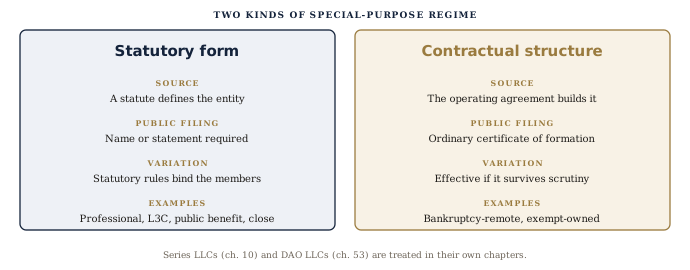
Relation to other chapters. Series LLCs are examined in chapter 10 and the DAO LLC in chapter 53, and neither is treated here except by cross-reference. The single-member LLC, which is the usual vehicle for the bankruptcy-remote structure and for the exempt organization's subsidiary, is examined in chapter 9. The tax classification rules that govern every LLC in this chapter are examined in Part VIII.
Organization. The chapter proceeds in nine parts:
- professional LLCs (¶ 1110);
- liability and regulation of professional LLCs (¶ 1120);
- the low-profit LLC (¶ 1130);
- program-related investments and the low-profit LLC (¶ 1140);
- statutory public benefit LLCs (¶ 1150);
- nonprofit and exempt-owned LLCs (¶ 1160);
- restricted-purpose and bankruptcy-remote LLCs (¶ 1170);
- close LLCs and other statutory variants (¶ 1180); and
- choosing and drafting the special-purpose LLC (¶ 1190).