

¶ 101
Overview
Scope of the chapter. This chapter traces the limited liability company from its antecedents to its present form and sets out the conceptual framework on which the remainder of the treatise relies. It explains the problem the form was devised to solve, the federal tax rules that delayed its adoption for most of the twentieth century, the statutes and rulings that allowed it to spread to every state, the second generation of statutes that followed the 1997 check-the-box regulations, and the competing theories of what an LLC is. A practitioner who understands that history will read the modern statutes with a clearer view of why their default rules take the form they do and where those rules remain unsettled.
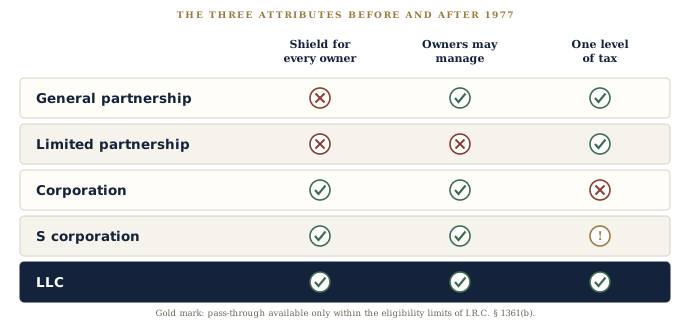
The defining attributes. The limited liability company combines three attributes that, before 1977, no single domestic business form offered together.
- A liability shield for every owner. No member or manager is liable for the obligations of the company solely by reason of being a member or acting as a manager. Del. Code Ann. tit. 6, § 18-303(a); Rev. Unif. Ltd. Liab. Co. Act § 304(a) (Unif. L. Comm'n 2006, amended 2013).
- Freedom to participate in management. Members may manage the business directly without forfeiting the shield. The limited partnership offered limited liability to its limited partners only on condition that they refrain from control, and the general partnership offered management rights only at the price of unlimited liability.
- Classification as a partnership for federal income tax purposes. Absent an election, a domestic LLC with two or more members is a partnership and a domestic LLC with one member is disregarded as an entity separate from its owner. Treas. Reg. § 301.7701-3(b)(1). Income is taxed once, at the level of the owners.
A fourth attribute, contractual flexibility, is a product of the modern statutes. Most of the governance and economic rules in an LLC statute are default rules that the operating agreement may vary, and in Delaware the statute declares a policy "to give the maximum effect to the principle of freedom of contract and to the enforceability of limited liability company agreements." Del. Code Ann. tit. 6, § 18-1101(b). That attribute is examined infra ch. 3.
Organization. The chapter proceeds in nine parts:
- the antecedents of the LLC in partnership law, in American experiments with limited partnership associations and business trusts, and in the civil-law limited company (¶ 110);
- the federal tax classification problem and the corporate-resemblance test (¶ 120);
- the Wyoming statute of 1977 and the Florida statute of 1982 (¶ 130);
- Revenue Ruling 88-76 and the spread of the form to every state (¶ 140);
- the check-the-box regulations (¶ 150);
- the second generation of statutes, including Delaware's freedom-of-contract amendments, the Revised Uniform Act, series and protected-series legislation and special-purpose LLCs (¶ 160);
- the LLC as it is used today, in the United States and abroad (¶ 170);
- the nature of the LLC as entity, contract and status (¶ 180); and
- the method of the treatise and how to use it (¶ 190).
Terminology. The statutes use different words for the same things. The treatise uses the terms below, and notes the Delaware or uniform-act equivalent where the difference matters.
| Term | Meaning in this treatise |
|---|---|
| LLC | A limited liability company formed under the law of a U.S. state or the District of Columbia; a non-U.S. entity with the same name is identified by its jurisdiction |
| Member | A person admitted as a member under the statute and the operating agreement, with the governance rights that admission carries |
| Manager | A person designated to manage a manager-managed LLC; the term does not include an officer or employee to whom authority is delegated |
| Operating agreement | The agreement of the members, written, oral or implied, governing the affairs of the LLC; called the "limited liability company agreement" in Delaware, Del. Code Ann. tit. 6, § 18-101(9), and the "operating agreement" in the uniform acts, Rev. Unif. Ltd. Liab. Co. Act § 102(13) |
| Certificate of formation | The public filing that brings the LLC into existence; called "articles of organization" in many states and the "certificate of organization" in the Revised Uniform Act |
| LLC interest | A member's entire interest in the LLC, comprising both governance rights and economic rights; Delaware's statutory term is "limited liability company interest," Del. Code Ann. tit. 6, § 18-101(10) |
| Transferable interest | The economic component of an LLC interest (the right to receive distributions), which a member may transfer without the consent of the other members unless the operating agreement provides otherwise |
| Dissociation | The end of a person's status as a member, whether by withdrawal, expulsion, death or another event |
| Eligible entity | A business entity that is not classified as a corporation under Treas. Reg. § 301.7701-2(b) and may therefore elect its classification |
| Disregarded entity | An eligible entity with a single owner that is treated as a division or branch of its owner for federal income tax purposes |
Reference statutes. No two LLC statutes are identical, and a treatise that tried to state the law of every state at every point would be unreadable. The treatise therefore takes two statutes as its principal references and notes significant departures from them. The first is the Delaware Limited Liability Company Act, Del. Code Ann. tit. 6, §§ 18-101 to 18-1109, which governs a large share of the LLCs used in sophisticated transactions and has generated the largest body of interpretive case law. The second is the Revised Uniform Limited Liability Company Act (2006, last amended 2013), which has been adopted, with variations, in a substantial minority of states and which represents the considered view of the Uniform Law Commission on the proper default rules. Where a state's statute departs in a way that affects planning or litigation, the departure is stated in the text and collected in Appendix A.
¶ 110
Antecedents
The problem the form solved. Before the LLC, an American business owner could have any two of the three attributes described in ¶ 101.02, and never all three. A corporation gave every shareholder limited liability and allowed shareholders to serve as directors and officers, but its income was taxed at the entity level and again when distributed. A general partnership gave its partners full management rights and a single level of tax, but every partner was personally liable for the partnership's debts. A limited partnership gave its limited partners a shield and a single level of tax, but the shield depended on the limited partners staying out of management, and the general partner remained personally liable. The LLC was devised to remove that choice. Its history is therefore the history of earlier attempts to combine the three attributes and of the tax rules that defeated most of them.
The general partnership. At common law, and under the Uniform Partnership Act of 1914, a partnership was an association of two or more persons to carry on as co-owners a business for profit. Unif. P'ship Act § 6(1) (1914). Each partner had an equal right to manage, Unif. P'ship Act § 18(e), and each partner was jointly and severally liable for the partnership's torts and jointly liable for its contracts, Unif. P'ship Act § 15. The partnership was treated for most purposes as an aggregate of its partners and dissolved on the withdrawal or death of any partner. Unif. P'ship Act §§ 29, 31. The aggregate conception shaped federal tax law, which never taxed the partnership itself and instead attributed its income to the partners. Many of the default rules found in modern LLC statutes, including equal management rights in a member-managed LLC, the requirement of unanimous consent for the admission of a new member and the distinction between a partner's interest in profits and the partner's right to participate in management, descend from the Uniform Partnership Act. Courts interpreting LLC statutes continue to draw on partnership precedent where the statute is silent (see infra ch. 3).
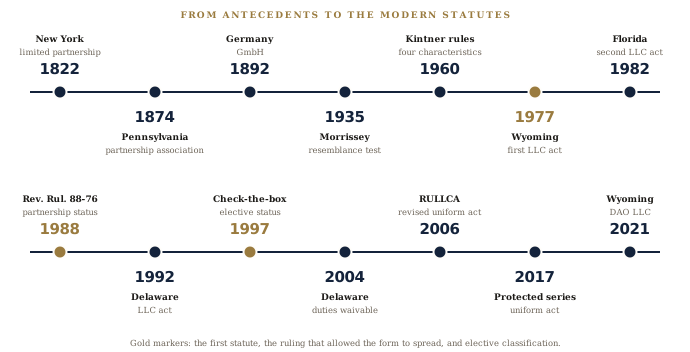
The limited partnership. The limited partnership came to the United States from the French société en commandite. New York enacted the first American limited partnership statute in 1822, and other states followed. The form offered limited liability to passive investors, who could lose no more than their contributions, while one or more general partners managed the business and bore unlimited liability. The early statutes were construed strictly, and a failure to comply with filing or naming requirements could expose the limited partners to general liability.
The Uniform Limited Partnership Act of 1916 made the bargain explicit: a limited partner who "takes part in the control of the business" became liable as a general partner. Unif. Ltd. P'ship Act § 7 (1916). The "control rule" produced a large and inconsistent body of case law on what activities amounted to control. The Revised Uniform Limited Partnership Act of 1976, as amended in 1985, narrowed the rule by listing activities that did not constitute control and by limiting liability to persons who transacted business with the partnership reasonably believing the limited partner to be a general partner. Rev. Unif. Ltd. P'ship Act § 303 (1976, amended 1985). The Uniform Limited Partnership Act of 2001 eliminated the control rule altogether. Unif. Ltd. P'ship Act § 303 (2001). By then the LLC had made the issue far less important in practice.
Practitioners responded to the control rule by organizing a corporation to serve as the sole general partner and having the limited partners own and direct that corporation. The device gave the investors indirect control and confined unlimited liability to a thinly capitalized corporation. It was widely used in real estate and oil and gas syndications. It is the immediate ancestor of the manager-managed LLC.
Partnership associations. In the late nineteenth century several states enacted statutes authorizing "limited partnership associations" or "partnership associations." Pennsylvania's Act of June 2, 1874, P.L. 271, was the model. An association was formed by filing a statement of its capital and the names of its members, and the members' liability was limited to the capital they subscribed. Management was vested in a board of managers elected by the members, and a member's interest could not be transferred to a person who would become a member without the consent of the other members. In structure the partnership association resembled the modern manager-managed LLC more closely than any other American form. It did not spread. Courts read the statutes as derogations from the common law, construed them narrowly, and held members personally liable for defects in formation or for doing business outside the state of organization. The associations also offered no tax advantage over the corporation once the federal income tax was enacted in 1913. Several other states enacted comparable statutes. A few of those statutes remained on the books well into the twentieth century, but the form had fallen almost entirely out of use long before the LLC appeared.
The business trust. The Massachusetts business trust was a common-law device by which investors transferred property to trustees who managed it for the benefit of holders of transferable certificates. If the trust instrument gave the certificate holders no power to control the trustees, the holders were not liable for the trust's obligations. If the holders could control the trustees, many courts treated the arrangement as a partnership and imposed personal liability. The business trust therefore offered limited liability and centralized management, but only by denying the owners the control that the LLC later gave them. For tax purposes the Supreme Court held that a business trust carrying on a business was an "association" taxable as a corporation. Hecht v. Malley, 265 U.S. 144 (1924). The business trust survives in modern form as the statutory trust, of which the Delaware Statutory Trust is the leading example, and is compared with the LLC infra ch. 4.
The civil-law limited company. The closest foreign antecedent of the LLC is the civil-law limited company, which combines limited liability for all owners with participation in management and restrictions on the transfer of interests. Germany enacted the Gesetz betreffend die Gesellschaften mit beschränkter Haftung (GmbHG) on April 20, 1892, creating the Gesellschaft mit beschränkter Haftung (GmbH). France introduced the société à responsabilité limitée (SARL) by the law of March 7, 1925. Portugal, Brazil, Spain, Italy and the republics of Latin America adopted similar forms, generally called limitadas. The characteristic features of those forms were the same in each jurisdiction:
- capital divided into quotas (Geschäftsanteile, parts sociales, cuotas) held by the members, with no shares issued to the public;
- management by one or more managers (Geschäftsführer, gérants, gerentes) appointed by the members, who could themselves be members;
- restrictions on the transfer of quotas to non-members without the consent of a stated majority; and
- limitation of each member's liability to the member's contribution.
The Wyoming statute of 1977 is generally said to have been drawn from the Panamanian sociedad de responsabilidad limitada (see infra ¶ 130.02). Whatever the precise source, the drafters borrowed from the civil-law model the concepts of a company owned by members instead of shareholders, managed by managers instead of directors, and protected by limited liability without incorporation.
Domestic responses within corporate law. Two developments within corporate and tax law reduced but did not remove the pressure for a new form. The first was the close-corporation statute. Beginning in the 1960s, states adopted statutes allowing shareholders of qualifying corporations to manage the business directly, dispense with a board, and restrict the transfer of shares. See, e.g., Del. Code Ann. tit. 8, §§ 341–356 (close corporations). Those statutes addressed governance but left the corporate double tax in place.
The second was the Subchapter S election, enacted by the Technical Amendments Act of 1958, Pub. L. No. 85-866, 72 Stat. 1606, which allowed a qualifying domestic corporation to pass its income through to its shareholders. The election came with conditions that remain in force in modified form: a limit on the number of shareholders, restrictions on who may be a shareholder (excluding partnerships, most trusts, corporations and nonresident aliens), and a single class of stock. I.R.C. § 1361(b). Those conditions made the S corporation unsuitable for ventures with institutional, foreign or entity investors and for arrangements that called for preferred returns or special allocations. They also meant that an inadvertent breach, such as a transfer of shares to an ineligible holder, could terminate the election. The S corporation is compared with the LLC infra chs. 4 and 43.
Why the form came late. By the middle of the twentieth century American law had accepted limited liability for owners of statutory entities, had accepted owner management of close corporations, and had developed sophisticated partnership law. The missing element was federal tax treatment. Any unincorporated entity that offered all of its owners limited liability and allowed them to manage the business risked classification as an "association" taxable as a corporation. Until that risk was resolved, a statute creating such an entity would have offered business owners the governance of a partnership, the liability of a corporation and the tax burden of a corporation, a combination with little appeal. ¶ 120 explains how the tax classification rules developed and why they produced that result.

¶ 120
The Tax Classification Problem
The statutory term "association." Since the early federal income tax statutes, the Internal Revenue Code has defined "corporation" to include "associations, joint-stock companies, and insurance companies." I.R.C. § 7701(a)(3). The Code has never defined "association." The question whether an unincorporated organization is an association, and therefore taxable as a corporation, has been answered over time by the courts and by regulations. Before 1997 the answer turned on the degree to which the organization resembled a corporation. For an entity designed to give all of its owners limited liability, that test posed an obvious difficulty, since limited liability was among the attributes most closely identified with incorporation.
The resemblance test. The Supreme Court stated the governing test in a case involving a business trust.
Kintner and the professional associations. After Morrissey the Treasury applied the resemblance test broadly, since the government's interest lay in classifying business entities as associations and collecting the corporate tax. That interest reversed when professionals sought corporate status in order to participate in tax-qualified retirement plans that were then unavailable to the self-employed. In United States v. Kintner, 216 F.2d 418 (9th Cir. 1954), a group of physicians in Montana reorganized their partnership as an unincorporated association with centralized management and continuity of life, and adopted a pension plan for its employees, including the physicians. The court held that the association was taxable as a corporation, with the result that the physicians were employees eligible for the plan. The government's response to Kintner produced the regulations that governed entity classification for the next thirty-six years.
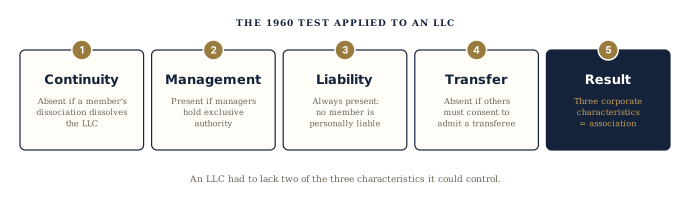
The 1960 regulations. The regulations adopted in 1960, known as the Kintner regulations, restated the Morrissey factors as six characteristics: (1) associates, (2) an objective to carry on business and divide the gains, (3) continuity of life, (4) centralization of management, (5) liability for debts limited to the property of the organization, and (6) free transferability of interests. Treas. Reg. § 301.7701-2(a)(1) (1960), T.D. 6503, 25 Fed. Reg. 10,928 (Nov. 17, 1960). Because the first two characteristics are common to corporations and partnerships, they were disregarded in classifying an organization that had associates and a business objective. Such an organization was classified as an association only if it had more corporate characteristics than noncorporate characteristics, which in practice meant at least three of the remaining four. Treas. Reg. § 301.7701-2(a)(3) (1960). The regulations also provided that the characteristics were to be determined under local law.
The regulations were designed to defeat professional associations. They operated to favor partnership classification in general, since an organization needed only two noncorporate characteristics to avoid association status. Taxpayers organizing limited partnerships for real estate and oil and gas syndications, which depended on the pass-through of losses, learned to draft for that result. The planning effort that later went into LLC statutes was first developed in the limited-partnership context.
The four characteristics applied. Each of the four operative characteristics had its own body of rules, and an LLC statute or operating agreement drafted before 1997 had to be tested against each of them.
- Continuity of life. An organization lacked continuity of life if the death, insanity, bankruptcy, retirement, resignation or expulsion of any member caused a dissolution of the organization under local law. Treas. Reg. § 301.7701-2(b)(1) (1960). An agreement under which the remaining members could continue the business after such an event did not supply continuity, provided their agreement to continue was required. The rule was later relaxed by revenue procedure to accept continuation by a majority in interest.
- Centralization of management. An organization had centralized management if any person or group of persons, less than all the members, had continuing exclusive authority to make management decisions. Treas. Reg. § 301.7701-2(c) (1960). A member-managed organization in which every member had authority lacked the characteristic.
- Limited liability. An organization had limited liability if no member was personally liable for its debts under local law. Treas. Reg. § 301.7701-2(d)(1) (1960). A limited partnership lacked the characteristic if its general partner had substantial assets or was not a dummy acting as agent of the limited partners. Treas. Reg. § 301.7701-2(d)(2) (1960).
- Free transferability of interests. An organization had free transferability if each member, or members owning substantially all of the interests, had the power without the consent of other members to substitute a non-member for themselves with all the attributes of membership. Treas. Reg. § 301.7701-2(e)(1) (1960). A power to assign only the right to share in profits, without the right to participate in management, did not amount to free transferability.
Equal weighting. The Service sometimes argued that a characteristic could be present in part, or that the characteristics should be weighed according to their importance. The Tax Court rejected that approach in the leading case.
The Court of Claims reached a similar result in Zuckman v. United States, 524 F.2d 729 (Ct. Cl. 1975), holding that a limited partnership with a corporate general partner lacked continuity of life and was properly classified as a partnership.
Consequence for an entity with full limited liability. An LLC, by definition, gives every member limited liability under local law. Under the 1960 regulations, an LLC therefore possessed the corporate characteristic of limited liability in every case. To avoid classification as an association, it had to lack two of the remaining three characteristics. Because many LLCs were expected to be managed by managers and would therefore have centralized management, the reliable course was to ensure that the LLC lacked both continuity of life and free transferability. That requirement is the origin of the dissolution and transfer rules of the early LLC statutes: dissolution on the death, withdrawal or bankruptcy of any member unless the remaining members agreed to continue, and admission of a transferee as a member only with the unanimous consent of the other members.
The 1980 proposed regulations. In November 1980 the Treasury proposed amendments to the classification regulations under which an organization whose members had no personal liability for its debts would have been classified as an association regardless of its other characteristics. Prop. Treas. Reg. § 301.7701-2, 45 Fed. Reg. 75,709 (proposed Nov. 17, 1980). The proposal would have ended the LLC before it began. It drew strong objections and was withdrawn in 1983, I.R.S. Announcement 83-4, 1983-2 I.R.B. 30, and the Service announced that it would study the classification of LLCs before issuing further guidance. During the period of study the Service did not issue rulings on the classification of LLCs. The uncertainty that resulted explains why no state followed Wyoming for five years and why the form remained little used until 1988.

¶ 130
The First Statutes: Wyoming (1977) and Florida (1982)
Origins of the Wyoming act. The first American LLC statute was enacted in Wyoming in 1977. The act was approved on March 4, 1977. It is generally attributed to the efforts of Hamilton Brothers Oil Company, an independent oil and gas company that had used foreign limited companies in its international operations and sought a domestic vehicle with the same combination of limited liability, owner participation in management and partnership tax treatment. The company had sought similar legislation in Alaska without success. Wyoming, with a legislature receptive to the oil and gas industry and a small body of corporate law, adopted the proposal.
Features of the 1977 statute. The Wyoming act was brief and drew its concepts from the civil-law limitada, of which the Panamanian sociedad de responsabilidad limitada is usually cited as the model. Its principal features were these:
- an LLC was formed by filing articles of organization with the Secretary of State;
- the members were not liable for the debts of the company;
- management was vested in the members unless the articles provided for management by managers;
- an LLC dissolved on the death, retirement, resignation, expulsion, bankruptcy or dissolution of a member, unless the business was continued by the consent of all remaining members under a right stated in the articles;
- a member could transfer the member's interest so as to admit the transferee as a member only with the unanimous written consent of the other members; and
- the articles were required to state a limited period of duration.
The dissolution and transfer rules tracked the 1960 regulations closely. They ensured that a Wyoming LLC lacked continuity of life and free transferability under local law, without regard to what its members agreed, and so could not have more than two corporate characteristics. The statute was what later commentators called "bulletproof": its mandatory rules secured partnership classification at the cost of flexibility.
The early rulings. In 1980 the Service issued a private letter ruling classifying a Wyoming LLC as a partnership. Priv. Ltr. Rul. 81-06-082 (Nov. 18, 1980). A private letter ruling may not be cited as precedent, I.R.C. § 6110(k)(3), and the ruling was followed within days by the proposed regulations described in ¶ 120.08, which would have reversed its result. For most of the 1980s, therefore, the tax classification of an LLC rested on a single private ruling and an announced study. Few practitioners were willing to advise clients to use the form.
Florida. Florida enacted the second LLC statute in 1982. Ch. 82-177, § 2, 1982 Fla. Laws (formerly codified at Fla. Stat. §§ 608.401–.514). The legislation was promoted as a means of attracting investment from Latin America, where the limitada was familiar. Its use was limited by the same federal uncertainty that affected Wyoming. The statute has since been replaced by the Florida Revised Limited Liability Company Act, ch. 2013-180, Laws of Fla. (codified at Fla. Stat. §§ 605.0101–605.1108), which is based in substantial part on the Revised Uniform Act.
The decade of limited use. From 1977 to 1988, LLCs were formed in small numbers, chiefly by sophisticated parties with international connections who were prepared to accept the classification risk or to structure around it. No other state adopted a statute during that period. Lawyers who wanted the attributes of the LLC continued to use the limited partnership with a corporate general partner (see supra ¶ 110.03), the S corporation where its eligibility rules could be met, and, for foreign investors, the foreign limited company. The experiment remained confined to two states until the Service resolved the classification question.
¶ 140
Revenue Ruling 88-76 and the Spread of the Form
The ruling. In 1988 the Service resolved its study of the Wyoming LLC and published a ruling holding that a Wyoming LLC was classified as a partnership. Rev. Rul. 88-76, 1988-2 C.B. 360. The ruling applied the 1960 regulations to the statute. It found that a Wyoming LLC had limited liability, because no member was personally liable for its debts, and centralized management, because the LLC in question was managed by designated managers. It found that the LLC lacked continuity of life, because the statute provided for dissolution on the death, retirement, resignation, expulsion, bankruptcy or dissolution of a member unless all remaining members consented to continue, and lacked free transferability, because a transferee could become a member only with the unanimous written consent of the other members. With two corporate and two noncorporate characteristics, the LLC was not an association. The ruling also confirmed that the absence of personal liability for every member did not by itself require association status, which disposed of the theory of the withdrawn 1980 proposal.
The legislative wave. After 1988 the form spread rapidly. Within five years of the ruling most states had enacted LLC statutes. Delaware enacted its Limited Liability Company Act in 1992. 68 Del. Laws ch. 434 (1992) (effective Oct. 1, 1992). By May 1996 the Treasury could report that "almost all states" had done so, 61 Fed. Reg. 21,989, 21,990 (proposed May 13, 1996), and the last two, Vermont and Hawaii, acted in 1996, with Hawaii's statute taking effect in 1997. The Service issued a series of revenue rulings addressing LLCs formed under particular state statutes, generally holding that an LLC formed under a statute with Wyoming-style dissolution and transfer rules, or under a flexible statute whose operating agreement supplied equivalent provisions, would be classified as a partnership. See, e.g., Rev. Rul. 93-38, 1993-1 C.B. 233 (Delaware LLCs). Those rulings were superseded in practical significance by the 1997 regulations but remain useful in interpreting agreements drafted in reliance on them.
Bulletproof and flexible statutes. The statutes enacted between 1988 and 1996 fell into two broad groups.
| Feature | Bulletproof statutes | Flexible statutes |
|---|---|---|
| Dissolution on dissociation of a member | Mandatory, subject to consent of remaining members to continue | Default rule; the operating agreement could provide otherwise |
| Admission of transferee as member | Mandatory unanimous or majority consent of non-transferring members | Default rule; the operating agreement could permit free admission |
| Classification risk | Low; the statute ensured that two corporate characteristics were absent | Depended on the operating agreement; a poorly drafted agreement could produce association status |
| Planning flexibility | Limited | Substantial |
| Examples | Wyoming (1977 act) and the early statutes modeled on it | Delaware (1992 act) |
The bulletproof statutes protected the unsophisticated user, since an LLC formed under them could not inadvertently become an association. The flexible statutes served sophisticated users who wanted to tailor dissolution and transfer rules. They placed the classification burden on the drafter. The flexible model prevailed, and after 1997 the bulletproof provisions lost their reason for existing. Most were repealed or converted into default rules (see infra ¶ 150.05).
Revenue Procedure 95-10. In 1995 the Service published the conditions under which it would issue rulings classifying an LLC as a partnership. Rev. Proc. 95-10, 1995-1 C.B. 501. The procedure addressed each characteristic. It accepted that an LLC lacked continuity of life if the dissociation of a member caused dissolution unless at least a majority in interest of the remaining members agreed to continue the business. It accepted that an LLC lacked free transferability if a majority of the non-transferring members was required to approve the admission of a transferee as a member. It treated a member-managed LLC as lacking centralized management. It imposed conditions on manager-managed LLCs, including requirements regarding the managers' ownership. It required that an LLC have at least two members. The procedure reflected the Service's growing acceptance of the form, and its relaxation of the continuity and transferability tests anticipated the end of the classification inquiry two years later.
Single-member LLCs before 1997. Under the 1960 regulations, the characteristic of "associates" presented a difficulty for an organization with a single owner. A one-member entity could not be a partnership, which by definition requires two or more persons, and the Service's position was that it would be classified either as an association or as a sole proprietorship depending on its characteristics. Several states declined to authorize single-member LLCs until the classification question was resolved, and those that did authorize them offered an entity of uncertain tax status. The 1997 regulations removed the difficulty by creating the disregarded entity, and every state now permits an LLC to have a single member. The single-member LLC is examined infra ch. 9.
Model and uniform legislation. The rapid enactment of state statutes produced considerable variation, and two drafting projects sought to bring order to the field. The American Bar Association's Section of Business Law issued a Prototype Limited Liability Company Act in 1992, which many states consulted. The National Conference of Commissioners on Uniform State Laws (now the Uniform Law Commission) approved the Uniform Limited Liability Company Act in 1994 and amended it in 1995 and 1996 (ULLCA, cited as Unif. Ltd. Liab. Co. Act (1996)). ULLCA was adopted in twelve jurisdictions, chiefly because most states had already enacted their own statutes by the time it was promulgated. Its significance lay in its treatment of fiduciary duties, its distinction between member-managed and manager-managed LLCs for purposes of agency and duty, and its rules on dissociation, which influenced later legislation and the Revised Uniform Act (see infra ¶ 160.03).
The limited liability partnership. A parallel development deserves mention. In 1991 Texas enacted the first statute permitting a general partnership to register as a limited liability partnership (LLP), shielding partners from personal liability for the malpractice of other partners. The LLP spread to every state during the 1990s, and the shield was broadened in most states to cover all partnership obligations. The LLP gave existing professional partnerships, especially law and accounting firms, a liability shield without the need to form a new entity. It remains the preferred form for many large professional firms, while the LLC is used by smaller firms and by most non-professional businesses. The LLP is compared with the LLC infra ch. 4.

¶ 150
The Check-the-Box Regulations
Notice 95-14. By the mid-1990s the classification regulations had become, in the Treasury's own description, largely formal. Taxpayers organizing unincorporated entities could secure partnership classification by drafting, and the Service devoted resources to ruling on drafting choices with no substantive tax consequence. In 1995 the Treasury announced that it was considering replacing the resemblance test with a regime under which an unincorporated entity could elect its classification. I.R.S. Notice 95-14, 1995-1 C.B. 297. The notice observed that the existing rules were complex, that the results they produced turned on drafting, and that small organizations without access to sophisticated advice bore a disproportionate share of the cost.
The 1996 final regulations. The Treasury adopted final regulations in December 1996, effective January 1, 1997. T.D. 8697, 61 Fed. Reg. 66,584 (Dec. 18, 1996). The regulations are organized in three sections.
- Treas. Reg. § 301.7701-1 provides that classification is a matter of federal law and does not depend on how the entity is classified under local law. It distinguishes business entities from trusts and from arrangements that do not create a separate entity, such as mere co-ownership of property.
- Treas. Reg. § 301.7701-2 defines a business entity as any entity recognized for federal tax purposes, including an entity with a single owner that may be disregarded, that is not properly classified as a trust or otherwise subject to special treatment. It identifies the entities that are corporations per se, including an entity organized under a federal or state statute that describes or refers to it as incorporated or as a corporation, body corporate or body politic, a joint-stock company, an insurance company, certain banks, an entity wholly owned by a state, and the foreign entities on a list of per se corporations. Treas. Reg. § 301.7701-2(b).
- Treas. Reg. § 301.7701-3 provides that a business entity that is not a per se corporation, an "eligible entity," may elect its classification. An eligible entity with at least two members may elect to be classified as an association or as a partnership. An eligible entity with a single owner may elect to be classified as an association or to be disregarded. Treas. Reg. § 301.7701-3(a).
Default classifications. The regulations supply a classification for an eligible entity that makes no election, and the defaults were chosen to give most entities the classification their owners would elect.
| Entity | Default classification | Authority |
|---|---|---|
| Domestic eligible entity, two or more members | Partnership | Treas. Reg. § 301.7701-3(b)(1)(i) |
| Domestic eligible entity, single owner | Disregarded as separate from its owner | Treas. Reg. § 301.7701-3(b)(1)(ii) |
| Foreign eligible entity, two or more members, at least one with unlimited liability | Partnership | Treas. Reg. § 301.7701-3(b)(2)(i)(A) |
| Foreign eligible entity, all members with limited liability | Association | Treas. Reg. § 301.7701-3(b)(2)(i)(B) |
| Foreign eligible entity, single owner with unlimited liability | Disregarded as separate from its owner | Treas. Reg. § 301.7701-3(b)(2)(i)(C) |
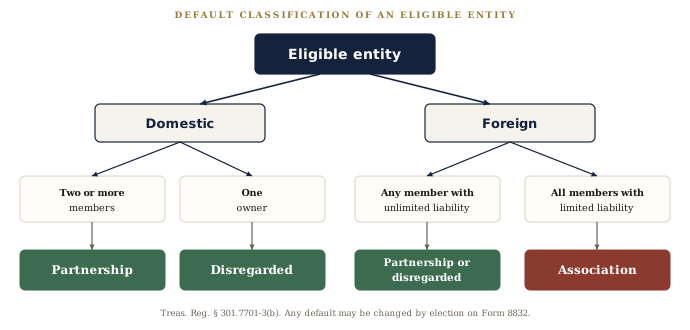
A domestic LLC therefore requires no election to be taxed as a partnership or disregarded. A foreign entity with the attributes of an LLC, such as a Nevis or Marshall Islands LLC, defaults to association status because none of its members has unlimited liability, and must elect if partnership or disregarded treatment is desired. The default rules for foreign entities are examined infra chs. 39 and 54.
Elections and changes in classification. An election is made on Form 8832 and may take effect up to seventy-five days before and up to twelve months after the date it is filed. Treas. Reg. § 301.7701-3(c)(1)(iii). After an election to change classification, the entity generally may not change its classification again for sixty months. Treas. Reg. § 301.7701-3(c)(1)(iv). A change in classification is treated as a deemed transaction: an election by a partnership to be classified as an association, for example, is treated as a contribution of the partnership's assets and liabilities to the association in exchange for its stock, followed by a distribution of the stock to the partners in liquidation of the partnership. Treas. Reg. § 301.7701-3(g)(1)(i). An election to be taxed as an S corporation requires both classification as an association and a separate election under I.R.C. § 1362, and an eligible entity that timely files a valid S election is deemed to have elected association status. Treas. Reg. § 301.7701-3(c)(1)(v)(C). Relief for late elections is available by revenue procedure. See Rev. Proc. 2013-30, 2013-36 I.R.B. 173.
Effect on state LLC statutes. The check-the-box regulations freed state legislatures from the need to write tax rules into entity law. Within a few years most states amended their statutes in three respects. First, they eliminated or relaxed the rule that the dissociation of a member dissolves the LLC, so that an LLC continues after a member's death, bankruptcy or withdrawal unless the operating agreement provides otherwise. Second, they authorized single-member LLCs everywhere. Third, many restricted or eliminated the default right of a member to withdraw and receive the fair value of the member's interest, a right that had served to deny continuity of life but that posed liquidity and valuation problems for the LLC and its remaining members. The Delaware act, for example, now provides that a member may not resign before dissolution unless the LLC agreement permits it. Del. Code Ann. tit. 6, § 18-603. The resulting statutes give the LLC a default continuity of life comparable to that of a corporation. The rules on dissociation and withdrawal are examined infra ch. 31.
Validity of the regulations. The regulations were challenged on the ground that the Treasury lacked authority to permit an entity to choose its classification and, in particular, to disregard a single-member LLC in collecting the owner's employment taxes. The courts of appeals upheld them. Littriello v. United States, 484 F.3d 372 (6th Cir. 2007); McNamee v. Dep't of the Treasury, 488 F.3d 100 (2d Cir. 2007). Both decisions applied the deference framework of Chevron U.S.A. Inc. v. Natural Resources Defense Council, Inc., 467 U.S. 837 (1984), which the Supreme Court overruled in Loper Bright Enterprises v. Raimondo, 603 U.S. 369 (2024). The Court stated in Loper Bright that its decision did not call into question the specific holdings of prior cases that relied on the Chevron framework. Id. at 412. Given that statement, the nearly three decades of reliance by taxpayers and the government, and the Treasury's express authority to prescribe classification rules, a successful challenge to the core of the regulations is unlikely. Practitioners should nonetheless follow any litigation that tests the regulations under the post-Loper Bright standard.
Limits of disregarded status. Disregarded status applies for federal income tax purposes and does not extend to every other purpose. Since 2009 a single-member LLC that is otherwise disregarded is treated as a corporation for purposes of employment taxes and certain excise taxes, so that it reports and pays employment taxes for its employees under its own employer identification number. Treas. Reg. § 301.7701-2(c)(2)(iv)–(v). A disregarded entity must also file information returns in some circumstances, including Form 5472 where it is wholly owned by a foreign person. Treas. Reg. § 1.6038A-1(c)(1). For state tax purposes, most states follow the federal classification, but some impose franchise, gross receipts or entity-level taxes on LLCs regardless of federal classification (see infra ch. 46). The protection that state law gives a disregarded LLC against the owner's creditors and the owner against the LLC's creditors is unaffected by its tax status (see infra chs. 9 and 25).
The significance of 1997. The check-the-box regulations completed the transformation that Revenue Ruling 88-76 began. Federal tax law ceased to dictate the content of state LLC statutes, and the statutes became free to choose default rules on the basis of business needs. The second generation of statutes, examined in ¶ 160, is the product of that freedom. The regulations also made the LLC the default vehicle for closely held business: an entity that could be taxed as a partnership, a disregarded entity, a C corporation or an S corporation, at the owners' choice, with the governance flexibility of a partnership and the liability protection of a corporation.
¶ 160
The Second Generation of Statutes
Three themes. The statutes as amended after 1997 differ from their predecessors in three principal respects. They give the operating agreement greater power to displace the statutory rules, including the rules on fiduciary duty. They give the LLC continuity of existence comparable to that of a corporation. And they recognize new variants of the form, including the series LLC, the protected series, the low-profit LLC, the benefit LLC and the decentralized autonomous organization LLC. Delaware and the Uniform Law Commission took different paths on the first of those themes, and the difference between them is the most important fault line in modern LLC law.
Delaware and freedom of contract. The Delaware act has from its enactment declared a policy of giving "the maximum effect to the principle of freedom of contract and to the enforceability of limited liability company agreements." Del. Code Ann. tit. 6, § 18-1101(b). The Delaware Supreme Court described the LLC agreement as the cornerstone of the entity and held that the act is primarily a statute of default rules that the members may displace by agreement. Elf Atochem N. Am., Inc. v. Jaffari, 727 A.2d 286, 290–91 (Del. 1999). The question that remained was whether the members could eliminate fiduciary duties altogether or only restrict them.
The Delaware act also permits an LLC agreement to limit or eliminate a member's or manager's liability for breach of contract and breach of duties, other than liability for a bad faith violation of the implied covenant. Del. Code Ann. tit. 6, § 18-1101(e). A later controversy concerned whether default fiduciary duties exist at all where the agreement is silent. The Court of Chancery held that they do. Auriga Capital Corp. v. Gatz Props., LLC, 40 A.3d 839, 849–56 (Del. Ch. 2012). On appeal the Supreme Court affirmed on the basis of the agreement's terms and described the Chancellor's discussion of default duties as unnecessary dictum. Gatz Props., LLC v. Auriga Capital Corp., 59 A.3d 1206, 1218–20 (Del. 2012). The General Assembly resolved the question in 2013 by amending § 18-1104 to provide that the rules of law and equity, including those relating to fiduciary duties, govern in any case not provided for in the act. Del. Code Ann. tit. 6, § 18-1104; 79 Del. Laws ch. 74, § 8 (2013). Default fiduciary duties and their modification are examined infra chs. 21 and 22.
The Revised Uniform Act. The Uniform Law Commission approved the Revised Uniform Limited Liability Company Act in 2006 (RULLCA) and amended it in 2011 and 2013, the latter as part of a project to harmonize the uniform unincorporated-entity acts. RULLCA differs from the Delaware act in its approach to the operating agreement. It lists matters the operating agreement may not alter, including the obligation of good faith and fair dealing. It permits the agreement to restrict or eliminate aspects of the duty of loyalty and to alter the duty of care only within stated limits, subject to a standard that the provision not be "manifestly unreasonable." Rev. Unif. Ltd. Liab. Co. Act § 105(c)–(e) (2006, amended 2013). Section numbers in this treatise follow the 2013 text, which renumbered several provisions of the 2006 act. Its other characteristic features include:
- abolition of the rule that a member is an agent of the LLC solely by reason of membership, with the result that authority depends on the law of agency and on any filed statement of authority (§§ 301, 302);
- a default rule of member management, with a manager-managed LLC created only by express provision in the operating agreement (§ 407);
- continuity of existence after the dissociation of a member, with no right of a dissociated member to be bought out (§§ 602, 603);
- the charging order as the exclusive remedy of a member's judgment creditor against the member's transferable interest (§ 503);
- judicial dissolution on the ground that those in control have acted or are acting in a manner that is oppressive and directly harmful to the applicant, together with authority to order remedies short of dissolution (§ 701(a)(4)(B), (b)); and
- detailed rules on direct and derivative actions (§§ 801–806).
RULLCA has been adopted, with variations, in about twenty jurisdictions, including the District of Columbia, and Rhode Island enacted it in 2026 with effect from January 1, 2028. P.L. 2026, ch. 247 (R.I.). Several adopting states depart substantially from the uniform text, among them North Dakota, whose act provides for a board of governors. Its provisions are the reference point for the uniform-act states throughout the treatise.
Series LLCs and protected series. In 1996 Delaware amended its act to permit an LLC agreement to establish designated series of members, managers, interests or assets, each with separate rights, powers and duties and, if statutory conditions are met, with the debts of each series enforceable only against the assets of that series. Del. Code Ann. tit. 6, § 18-215; 70 Del. Laws ch. 360, § 9 (1996) (effective Aug. 1, 1996). A number of states adopted similar provisions. In 2017 the Uniform Law Commission approved the Uniform Protected Series Act, a free-standing act designed to be added to a state's LLC statute and enacted in Nebraska (2018), Iowa (2019) and Virginia (2019), among others, which provides detailed rules on the formation of protected series, the enforcement of internal shields against creditors and the treatment of protected series in other states and in insolvency. Delaware added the "registered series," a series that files its own certificate with the Secretary of State, with effect from August 1, 2019. Del. Code Ann. tit. 6, §§ 18-218 to 18-221; 81 Del. Laws ch. 357 (2018). The Treasury proposed regulations in 2010 that would treat each series as a separate entity for federal tax purposes, Prop. Treas. Reg. § 301.7701-1(a)(5), 75 Fed. Reg. 55,699 (proposed Sept. 14, 2010), but those regulations have not been finalized. Series and protected-series LLCs are examined infra ch. 10.
Special-purpose variants. States have also created LLC variants for particular purposes.
| Variant | Purpose | First or leading statute |
|---|---|---|
| Professional LLC | Practice of a licensed profession, with the professional's liability for the professional's own negligence preserved | Most states, by separate article or statute |
| Low-profit LLC (L3C) | Ventures with a charitable or educational purpose that seek program-related investments from private foundations | Vermont, 2008 |
| Benefit LLC / public benefit LLC | Pursuit of a stated public benefit alongside profit | Delaware, 2018, Del. Code Ann. tit. 6, §§ 18-1201 to 18-1208 |
| Decentralized autonomous organization (DAO) LLC | Entities managed in whole or part by smart contracts | Wyoming, 2021 Wyo. Sess. Laws ch. 162, Wyo. Stat. Ann. §§ 17-31-101 to -116; Utah, 2023, Utah Code Ann. § 48-5-101 et seq. |
The low-profit LLC drew interest for a time but has been repealed in North Carolina and is little used. The DAO LLC is examined infra ch. 53 and the remaining variants infra ch. 11.
Entity transactions. The second-generation statutes also made the LLC a full participant in entity transactions. Every state now permits an LLC to merge with other LLCs and with other types of entity, and nearly every state permits an LLC to convert into another type of entity and to domesticate from or to another jurisdiction. Delaware added a statutory division in 2018, permitting an LLC to divide into two or more LLCs and allocate its assets and liabilities among them. Del. Code Ann. tit. 6, § 18-217; 81 Del. Laws ch. 357 (2018) (effective Aug. 1, 2018). Those transactions are examined infra ch. 34.
The single-member LLC and the charging order. One further development illustrates the interaction between LLC law and creditors' rights. In Olmstead v. FTC, 44 So. 3d 76 (Fla. 2010), the Florida Supreme Court held that the charging-order provision of the former Florida statute did not bar a court from ordering the owner of a single-member LLC to surrender the entire LLC interest to satisfy a judgment. Several states have confirmed by statute that the charging order is the exclusive remedy against a member's interest, including the interest of a sole member. Wyoming enacted such a provision in March 2010, while Olmstead was pending before the Florida Supreme Court on a question certified by the Eleventh Circuit. 2010 Wyo. Sess. Laws ch. 94. Wyo. Stat. Ann. § 17-29-503(g). Florida responded by codifying a limited form of the Olmstead result. Under the Florida Revised Limited Liability Company Act, the charging order is the sole and exclusive remedy of a member's judgment creditor, except that, "[i]n the case of a limited liability company that has only one member," a court may order the foreclosure sale of the sole member's interest on a showing that distributions under a charging order will not satisfy the judgment within a reasonable time. Fla. Stat. § 605.0503(3)–(4). Foreclosure is barred where the LLC has more than one member. Id. § 605.0503(6).
The reach of the Florida foreclosure remedy turns on the act's definitions. The act uses "limited liability company" and "foreign limited liability company" as discrete terms. "Limited liability company," "except in the phrase 'foreign limited liability company,'" means an entity formed or existing under the Florida act or one that has become subject to it by an entity transaction. Fla. Stat. § 605.0102(36). A "foreign limited liability company" is an unincorporated entity formed under the law of another jurisdiction and denominated by that law as a limited liability company. Id. § 605.0102(26). Section 605.0503(4) authorizes foreclosure only in the case of a "limited liability company" that has only one member. It does not refer to a foreign limited liability company. The statutory authority to foreclose on a single member's interest therefore extends only to Florida LLCs and does not reach an LLC organized in another jurisdiction. The act's internal-affairs provision is consistent with that reading: the law of the jurisdiction under which a foreign LLC exists governs its organization and internal affairs and the liability of its members and managers. Id. § 605.0901(1). A Florida judgment creditor of the sole member of a Delaware, Wyoming or Nevada LLC must look to the law of the state of formation, and not to § 605.0503(4), for any remedy beyond the charging order. The charging order is examined infra ch. 27 and, from the standpoint of asset protection planning, in the companion volume, Lighthouse on Asset Protection ch. 16.

¶ 170
The LLC Today
Prevalence. The LLC is now the most common form of new business entity in the United States. In Delaware, which remains the leading jurisdiction for entities used in financial and corporate transactions, 235,393 new LLCs were formed in 2025, 70.4 percent of all new entities, and LLCs numbered 1,653,329 of the 2,287,728 entities on the state's register at year end. Del. Div. of Corps., 2025 Annual Report. On the federal tax side, LLCs accounted for 72.7 percent of the 4,575,280 partnership returns filed for tax year 2023, about 3.3 million returns, and have been the most common type of filer for twenty-two consecutive years. Ron DeCarlo, Tuba Ozer-Gurbuz & Nina Shumofsky, Partnership Returns, Tax Year 2023, SOI Bull. (I.R.S. Fall 2025). Single-member LLCs, which do not file entity-level income tax returns, are not captured in those figures and add substantially to the total.
Uses. The form's flexibility has made it the vehicle of choice for a wide range of purposes. The principal uses, each examined in a later chapter, are these:
- operating businesses of every size, from sole proprietorships to large private companies (see infra chs. 17–24);
- real estate ownership and development, where the pass-through of losses and the use of single-asset entities are standard (see infra ch. 51);
- joint ventures between corporations, which use the LLC to combine a liability shield with tailored governance and economics (see infra ch. 52);
- private investment funds and their sponsors, which typically use LLCs as general partners, management companies and holding entities (see infra ch. 52);
- special-purpose and bankruptcy-remote entities in structured finance, using the Delaware "springing member" and independent-manager provisions (see infra ch. 49);
- family wealth and succession planning, including family LLCs used to centralize management and facilitate gifts (see infra ch. 50);
- professional practices, through professional LLCs (see infra ch. 11); and
- holding and protecting assets, often in combination with trusts (see infra ch. 9, and Lighthouse on Asset Protection chs. 15–16).
Recognition in federal law. Federal statutes and decisions generally treat an LLC according to its nature under state law, but particular federal doctrines treat it in ways that surprise practitioners accustomed to corporate rules.
- Diversity jurisdiction. An LLC is a citizen of every state of which any of its members is a citizen, and its state of organization and principal place of business are irrelevant. The rule follows from Carden v. Arkoma Associates, 494 U.S. 185 (1990), which held that an unincorporated association takes the citizenship of each of its members, and every circuit has applied it to LLCs. See, e.g., Johnson v. Columbia Props. Anchorage, LP, 437 F.3d 894, 899 (9th Cir. 2006); Zambelli Fireworks Mfg. Co. v. Wood, 592 F.3d 412, 420 (3d Cir. 2010). Where a member is itself an LLC or partnership, citizenship must be traced through each layer (see infra ch. 37).
- Bankruptcy. An LLC is a "corporation" within the meaning of the Bankruptcy Code, which defines the term to include an "unincorporated company or association." 11 U.S.C. § 101(9)(A)(iv). It may therefore be a debtor under chapter 7 or chapter 11. The treatment of a member's LLC interest in the member's own bankruptcy, and the enforceability of operating-agreement provisions triggered by bankruptcy, are examined infra ch. 49.
- Securities law. Whether an LLC interest is a security depends on the economic realities of the arrangement, and in particular on whether the members rely on the efforts of others for their profits. See SEC v. W.J. Howey Co., 328 U.S. 293 (1946). Interests in member-managed LLCs are usually not investment contracts, and interests in manager-managed LLCs frequently are (see infra ch. 47).
- Beneficial-ownership reporting. The Corporate Transparency Act, 31 U.S.C. § 5336, required most LLCs to report their beneficial owners to the Financial Crimes Enforcement Network. In March 2025 FinCEN issued an interim final rule exempting entities created in the United States from the reporting requirement and limiting it to foreign entities registered to do business in a state. Beneficial Ownership Information Reporting Requirement Revision and Deadline Extension, 90 Fed. Reg. 13,688 (Mar. 26, 2025). The current state of the rules is examined infra ch. 48.
Recognition abroad. U.S. LLCs are widely used by non-U.S. persons and in cross-border structures, and their treatment by foreign tax authorities is a recurring source of difficulty. Because a domestic LLC is fiscally transparent for U.S. purposes unless it elects otherwise, while many foreign systems classify entities by their corporate attributes, an LLC may be transparent in the United States and opaque in the member's country of residence, or the reverse. In Anson v. Commissioners for Her Majesty's Revenue & Customs [2015] UKSC 44, the United Kingdom Supreme Court held that a U.K.-resident member of a Delaware LLC was entitled to double taxation relief for U.S. tax paid on his share of the LLC's profits, on the ground that the First-tier Tribunal had found, on the evidence of Delaware law and the LLC agreement, that the members were entitled to their shares of the profits as they arose. The Court did not hold that Delaware LLCs are transparent for all U.K. tax purposes. HMRC responded that it would continue to treat U.S. LLCs as opaque entities in general and to consider claims under Anson case by case, treating the decision as dependent on its facts. Hybrid-entity mismatches of this kind are now addressed by anti-hybrid rules in many jurisdictions and in the United States, I.R.C. § 267A. Treaty access for income derived through fiscally transparent entities is addressed in U.S. income tax treaties and in the U.S. Model Income Tax Convention art. 1(6) (2016). Several non-U.S. jurisdictions have enacted LLC statutes of their own, among them Nevis, the Marshall Islands, the Cook Islands, the Isle of Man and the Cayman Islands. These are examined infra ch. 54.
Unsettled questions. Despite nearly fifty years of development, a number of important questions remain unsettled or divided among the states. The principal ones, each treated in the chapter indicated, are these:
| Question | Where the law stands | Chapter |
|---|---|---|
| Scope of contractual elimination of fiduciary duties | Permitted in Delaware; limited in RULLCA states; varies elsewhere | 22 |
| Reach of the implied covenant of good faith and fair dealing | Narrow gap-filler in Delaware; broader in some states | 22 |
| Veil piercing of single-member LLCs | Most states apply corporate tests with adjustments for LLC informality; some statutes limit the role of formalities | 26 |
| Exclusivity of the charging order for single-member LLCs | Divided; depends on statute and on the court | 27 |
| Recognition of internal series shields outside the formation state and in bankruptcy | Largely untested | 10, 49 |
| Enforceability of bankruptcy-triggered dissociation and governance provisions | Divided under 11 U.S.C. §§ 365(e) and 541(c) | 49 |
| Availability of judicial dissolution or buyout for oppression | Statutory in RULLCA and some other states; unavailable in Delaware absent agreement | 32 |
| Durability of the check-the-box regulations after Loper Bright | Upheld under Chevron; prior holdings stand absent new challenge | 39 |
The LLC and the corporation compared in use. The LLC has not displaced the corporation for every purpose. Businesses that expect to raise venture capital generally organize as Delaware corporations, because venture funds commonly have tax-exempt and foreign investors who wish to avoid income effectively connected with a U.S. trade or business and unrelated business taxable income, because the qualified small business stock exclusion of I.R.C. § 1202 is available only for C corporation stock, and because public-company practice and equity-compensation conventions are built around corporate stock. Businesses that expect to go public also usually adopt the corporate form, although some public companies use LLC or limited partnership structures for tax reasons. For closely held businesses that do not expect institutional equity, the LLC is the default choice. The comparison is examined in detail infra ch. 4.
¶ 180
The Nature of the LLC: Entity, Contract and Status
Three conceptions. Courts and commentators have described the LLC in three ways. In the first, it is a separate legal entity, like a corporation, distinct from its members and capable of owning property, contracting and suing in its own name. In the second, it is a contract among its members, whose rights and duties are set by the operating agreement and enforced as contractual obligations. In the third, it is a statutory status, a relationship whose incidents are fixed by the statute and by the general law of partnership and equity to the extent the members have not displaced them. Each conception is accurate in part, and each controls the answer to a different set of questions. The skill required of a practitioner lies in recognizing which conception a court is likely to apply to the question at hand.
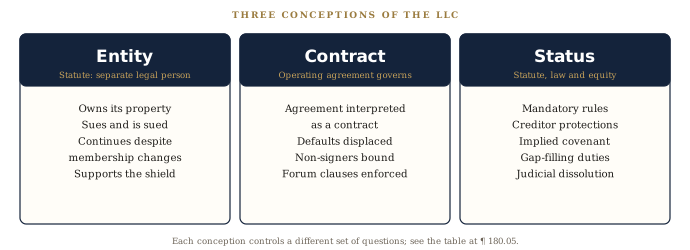
The LLC as entity. Every modern statute declares the LLC to be a separate legal entity. Del. Code Ann. tit. 6, § 18-201(b); Rev. Unif. Ltd. Liab. Co. Act § 108(a). The entity conception governs at least the following matters:
- Ownership of property. Property acquired by the LLC is its property, and a member has no interest in specific LLC property. Del. Code Ann. tit. 6, § 18-701. A member's creditors therefore cannot levy on the LLC's assets to satisfy the member's debts (see infra ch. 27).
- Litigation. The LLC sues and is sued in its own name, and a claim for injury to the LLC belongs to it, to be asserted by the LLC or derivatively by a member (see infra ch. 35).
- Continuity. The LLC continues in existence notwithstanding changes in its membership, unless the operating agreement or statute provides for dissolution.
- The liability shield. The members' immunity from the LLC's obligations presupposes that those obligations are the entity's and no one else's (see infra ch. 25).
The LLC as contract. The Delaware courts have repeatedly described the LLC as a creature of contract. The leading decision is the following.
The contract conception governs the interpretation of the operating agreement, which Delaware courts construe under the ordinary principles of contract interpretation, the enforceability of provisions limiting duties and remedies, and the role of the implied covenant of good faith and fair dealing as a gap-filler (see infra chs. 7, 8 and 22). It also explains the rule, adopted in Delaware and in the uniform acts, that a person who is admitted as a member or who receives a transferable interest is bound by the operating agreement whether or not that person signs it. Del. Code Ann. tit. 6, § 18-101(9); Rev. Unif. Ltd. Liab. Co. Act § 106.
The LLC as statutory status. The contract conception has limits. A statute that confers limited liability on the members of an entity affects third parties who are not parties to the operating agreement, and the legislature retains rules that the agreement cannot vary. Those rules include the requirement of a filed certificate, the protection of creditors against distributions that render the LLC insolvent, the implied covenant, and, in RULLCA states, the list of non-waivable provisions in § 105(c). Where the statute and the agreement are silent, courts fill the gaps by reference to the general law. Delaware does so by statutory direction, providing that "the rules of law and equity" govern in any case not provided for in the act. Del. Code Ann. tit. 6, § 18-1104. In practice, courts draw on partnership law for questions of member rights and duties and on corporate law for questions of entity governance, veil piercing and derivative litigation. The choice between the two sources is not always predictable. A practitioner advising on an unsettled question should consider how a court would reason from each.
The conceptions applied. The following table shows how the three conceptions bear on recurring questions.
| Question | Conception that usually controls | Illustration |
|---|---|---|
| Can a member's creditor reach LLC assets? | Entity | Creditor limited to a charging order against the member's transferable interest |
| Who may sue for harm to the LLC? | Entity | The LLC, or a member derivatively, subject to demand and standing rules |
| May members eliminate fiduciary duties? | Contract (Delaware); status (RULLCA states) | Delaware permits elimination; RULLCA limits it |
| Is a non-signing member bound by the forum clause? | Contract | Yes, under the Delaware act and Elf Atochem |
| May a court dissolve the LLC for oppression? | Status | Statutory ground in RULLCA states; Delaware limits judicial dissolution to the statutory standard of reasonable impracticability |
| What duties does a manager owe where the agreement is silent? | Status (law and equity) | Default duties of loyalty and care under Del. Code Ann. tit. 6, § 18-1104 |
| Is the LLC's separate existence respected? | Entity, subject to equitable veil piercing | Corporate veil-piercing tests applied with adjustments |
The member's interest as property. A member's interest in the LLC is personal property. Del. Code Ann. tit. 6, § 18-701; see Rev. Unif. Ltd. Liab. Co. Act § 501 (transferable interest). The interest has two components: the economic right to share in profits, losses and distributions, which the member may transfer, and the governance rights of membership, which a transferee acquires only on admission as a member. A transferee who is not admitted holds only the economic right and has no right to participate in management or, in most states, to obtain information beyond limited financial statements. That division, inherited from partnership law, determines the rights of assignees, judgment creditors, heirs and bankruptcy trustees. The same division underlies the charging order. It is examined infra chs. 27 and 29.
Choosing between conceptions in argument. The conceptions are tools of argument as well as description. A party seeking to enforce a waiver of fiduciary duty will stress the contractual nature of the LLC and the statutory policy of freedom of contract. A party resisting the waiver will stress the statute's non-waivable provisions, the equitable origins of fiduciary duty and the effect on persons who did not negotiate the agreement. A creditor seeking to reach a member's assets will invoke the equitable doctrine of veil piercing and characterize the LLC as a mere instrumentality, while the member will rely on the entity conception and the statutory shield. Courts have not adopted any one conception as controlling for all purposes. The treatise therefore identifies, for each question it addresses, the conception on which the courts have relied.

¶ 190
Using This Treatise
Plan of the work. The treatise is organized in nine parts. Part I (chs. 1–4) examines the foundations of the form. Part II (chs. 5–12) addresses formation and organization, including the choice of jurisdiction, the operating agreement and the special forms. Part III (chs. 13–16) examines capital and economic rights. Part IV (chs. 17–24) addresses governance and fiduciary duty. Part V (chs. 25–28) examines the liability shield and its limits. Part VI (chs. 29–34) addresses changes in ownership and structure. Part VII (chs. 35–38) addresses litigation. Part VIII (chs. 39–46) examines taxation. Part IX (chs. 47–55) addresses regulation and special settings and concludes with a clause-by-clause guide to drafting the operating agreement. Appendices A through G contain a fifty-state statutory survey, comparison tables for the uniform acts and Delaware, model operating agreements, forms, a tax elections calendar, checklists and a glossary.
Numbering and cross-references. Each chapter is divided into sections numbered in tens (¶ 110, ¶ 120) and paragraphs numbered in hundredths (¶ 110.01). Chapter 10 and later chapters use four-digit section numbers (¶ 1010, ¶ 1010.01). Cross-references within the treatise use see supra for earlier material and see infra for later material. References to the companion volume give its title and chapter.
Features of each chapter. Each chapter opens with an overview stating its scope and organization. Within the chapter, four kinds of set-off material supplement the text:
- Examples, numbered by chapter (Example 1-1, 1-2), apply the rules to facts of the kind practitioners encounter;
- Case discussions set out the facts, proceedings, holding and lessons of the leading decisions;
- Planning Notes identify drafting and transactional steps that follow from the analysis; and
- Comments state the editors' views on unsettled questions and on the direction of the law.
Citation conventions. Citations follow The Bluebook: A Uniform System of Citation. The following abbreviations are used:
| Abbreviation | Meaning |
|---|---|
| Delaware act; DLLCA | Delaware Limited Liability Company Act, Del. Code Ann. tit. 6, §§ 18-101 to 18-1109 |
| ULLCA | Uniform Limited Liability Company Act (1995, amended 1996) |
| RULLCA | Revised Uniform Limited Liability Company Act (2006, amended 2011 and 2013) |
| UPA; RUPA | Uniform Partnership Act (1914); Revised Uniform Partnership Act (1997) |
| ULPA; RULPA | Uniform Limited Partnership Act (1916 or 2001, as indicated); Revised Uniform Limited Partnership Act (1976, amended 1985) |
| I.R.C.; Code | Internal Revenue Code of 1986, as amended, 26 U.S.C. |
| Treas. Reg. | Treasury Regulations, 26 C.F.R. |
State statutes are cited to the official code where one exists. Appendix A collects the citations for each state.
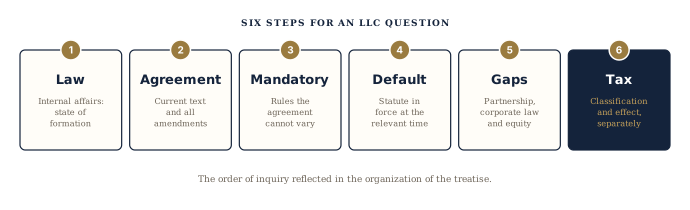
Reading an LLC question. The following sequence of inquiries applies to most questions of LLC law and is reflected in the organization of the chapters that follow.
- Identify the governing law. The law of the state of formation governs the LLC's internal affairs, including the relations among members and managers and the liability of members for the LLC's obligations (see infra ch. 12). Questions of tort, contract with third parties, property and taxation may be governed by other law.
- Read the operating agreement. Because most statutory rules are defaults, the agreement is the first source of the answer. Confirm that the version relied on is the current one, that all amendments were adopted in accordance with the agreement, and whether the agreement is written, oral or implied (see infra chs. 7 and 8).
- Identify mandatory statutory rules. Determine whether the statute prevents the agreement from altering the rule at issue, by reference to the list of non-waivable provisions in uniform-act states or the narrower limits in Delaware (see infra ch. 3).
- Apply the statutory default. Where the agreement is silent, apply the statute, taking care to use the version in force at the relevant time, and consider whether a later amendment applies to an LLC formed before its effective date.
- Fill remaining gaps. Where the statute is silent, consider the general law of partnership, corporations, agency and equity, and the conception of the LLC that the question engages (see supra ¶ 180).
- Check the tax consequences separately. The tax classification of the LLC and the tax effect of any transaction are determined under federal and state tax law and do not follow automatically from the entity-law analysis (see infra Part VIII).
The companion volume. This treatise and Lighthouse on Asset Protection are designed to be used together. Where the LLC is examined as a tool for protecting assets from creditors, including charging-order protection, the single-member LLC, the choice of Wyoming or Nevis law and the use of LLCs in layered structures with trusts, this treatise states the entity law and the companion volume examines the planning considerations and the creditor's remedies in full. Cross-references to the companion volume are given at each point of overlap.
Currency. The law is stated as of November 2026. Statutes, regulations and decisions after that date are not reflected. Because LLC statutes are amended frequently and the case law develops quickly, particularly in Delaware, readers should confirm the current text of any statute and the subsequent history of any decision before relying on it.