

¶ 4001
Overview
Scope of the chapter. This chapter examines the regulation of digital assets in three Asia-Pacific jurisdictions that matter to practitioners advising clients with business, custody or family wealth in the region: Singapore, Hong Kong and the Philippines. It then compares, more briefly, the regimes of Japan, the Republic of Korea and Australia. For each of the three principal jurisdictions the chapter identifies the statute and the regulator, the activities that require a licence, the rules that govern the safekeeping of customer assets, the restrictions placed on dealings with retail customers, the treatment of stablecoins, and the decisions of the courts that bear on the private-law position of customers. The chapter closes with the considerations that bear on the choice of an Asia-Pacific base and a checklist.
Why these jurisdictions. Singapore and Hong Kong are the two principal financial centres of the region, and each has built a licensing regime for virtual-asset businesses that it presents as a means of attracting regulated activity while excluding unregulated activity. The Philippines is a large retail market with an active remittance sector, a central bank that has regulated virtual asset service providers since 2017, and a securities regulator that in 2025 brought crypto-asset service providers within a separate registration regime. The three present different models. Singapore regulates digital payment token services as payment services under a payments statute and has added a separate regime for providers that serve only customers abroad. Hong Kong regulates trading platforms under its anti-money-laundering ordinance with a parallel securities licence, and regulates stablecoin issuers under a dedicated ordinance administered by its monetary authority. The Philippines divides the field between the Bangko Sentral ng Pilipinas, which treats virtual asset service providers as money service businesses, and the Securities and Exchange Commission, which regulates crypto-asset service providers and offerings.
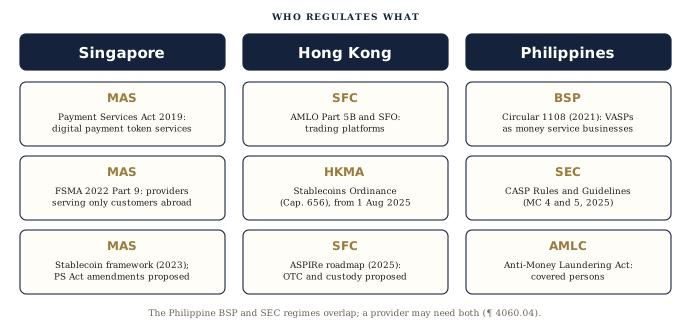
Relation to other chapters. The property characterization of digital assets in the Singapore and Hong Kong courts is examined in ch. 4, and this chapter refers to those decisions only for their regulatory consequences. Custody models and the custodial relationship are treated in chs. 9 and 10, staking in ch. 12, exchange failures in ch. 28, international tax reporting under the Crypto-Asset Reporting Framework in ch. 32, anti-money-laundering obligations and the travel rule in chs. 33 and 34, stablecoin regulation in the United States in ch. 37, and the European Union and the Gulf and offshore centres in chs. 38 and 39.
Common features. Several features recur across the region. Each of the principal jurisdictions:
- requires a licence or registration for businesses that exchange, transfer or safeguard digital assets for customers, following Recommendation 15 of the Financial Action Task Force (see ch. 33);
- requires customer assets to be segregated from the provider's own assets, and in Singapore and Hong Kong requires them to be held on trust for customers;
- restricts retail access through suitability or risk-awareness assessments, limits on incentives and leverage, and rules on which tokens may be offered;
- has adopted or proposed a separate framework for fiat-referenced stablecoins; and
- has committed to implement the Crypto-Asset Reporting Framework, with first exchanges in 2028 for Singapore, Hong Kong and the Philippines (see ch. 32).
Points of difference. The regimes differ on matters that decide where a business should be established and how a client's assets will be treated if a provider fails. The most important differences are: whether a provider established locally but serving only foreign customers must be licensed (Singapore requires it since 30 June 2025); whether retail customers may use staking services offered by the platform (Singapore restricts it; Hong Kong permits it under conditions set in 2025); whether stablecoins are regulated as a distinct product (Hong Kong since 1 August 2025; Singapore under a 2023 framework that is being placed on a statutory footing; the Philippines without a dedicated regime); and whether new licences are available at all (the Bangko Sentral has closed its regular window for new virtual asset service provider licences since 1 September 2022).
Method and sources. The chapter states the law as of November 2026. It relies on the statutes, regulations, guidelines and official statements of the regulators wherever these could be read. Where only a summary by the regulator or by practitioners was available, the text says so. Regulatory regimes in the region change frequently, and several of the measures described below were consultations or newly commenced regimes when this chapter was written. Practitioners should confirm the current position with the regulator before acting.
Organization. Paragraphs 4010 and 4020 treat Singapore: the Payment Services Act 2019 and the consumer-protection guidelines for digital payment token service providers, then the regime for digital token service providers under the Financial Services and Markets Act 2022, the stablecoin framework and the decisions of the Singapore courts. Paragraphs 4030 and 4040 treat Hong Kong: the licensing of virtual asset trading platforms, then the Stablecoins Ordinance, the SFC's 2025 roadmap, staking and exchange-traded funds, and the JPEX case. Paragraphs 4050 to 4070 treat the Philippines: the Bangko Sentral's regime, the SEC's crypto-asset service provider rules, and anti-money-laundering, the exit from the FATF grey list and tax. Paragraph 4080 compares Japan, Korea and Australia, and ¶ 4090 addresses the choice of a base and sets out a checklist.
Comment. The regulators of the region describe their regimes in similar terms, emphasizing consumer protection and market integrity. The legal consequences of a provider's failure, however, depend on the private law of the jurisdiction and on the terms on which assets are held. The statutory trust required in Singapore and the trust arrangements required in Hong Kong are designed to change those consequences, and the decisions in Re Gatecoin and Re Zipmex show what happened to customers before such requirements applied (see ¶¶ 4020 and 4040).