

¶ 3501
Overview
Scope of the chapter. This chapter examines when an offer or sale involving a digital asset is an offer or sale of a security under the federal securities laws, and what follows when it is. It covers the statutory definition of "security," the investment-contract test of SEC v. W.J. Howey Co., 328 U.S. 293 (1946), the Commission's 2017 report on The DAO, the litigated token cases from Telegram and Kik to Ripple, Terraform, Coinbase and Binance, the change in the Commission's approach that began in January 2025, the joint SEC and CFTC interpretation issued in March 2026, the exemptions available for token offerings including the proposed Regulation Crypto Assets, the registration status of trading platforms, and the liability of platforms as statutory sellers under section 12(a)(1) of the Securities Act. Commodities and derivatives regulation, and the market-structure legislation pending in Congress, are treated in ch. 36. Stablecoins are treated in ch. 37. Custody by advisers, funds, broker-dealers and banks is treated in ch. 11, and staking programs in ch. 12.
Why the question matters. Classification decides almost everything else. If a transaction is an offer or sale of a security, section 5 of the Securities Act requires registration or an exemption, purchasers have a statutory rescission right under section 12(a)(1) against those who sold to them in violation of section 5, the antifraud provisions apply with their full reach, and intermediaries that match orders, effect transactions or settle trades may need to register as exchanges, brokers, dealers or clearing agencies. If the transaction is outside the definition, those consequences fall away, and the asset is left to commodities law, state money-transmission law, consumer-protection law and the general law of contract and property. The chapters on custody (chs. 9 to 11), insolvency (chs. 27 to 29) and tax (chs. 30 to 32) each assume that the practitioner has first decided this question.
The structure of the analysis. The analysis proceeds in four steps. The first asks whether the asset is itself a security because it is, or digitally represents, one of the instruments named in the statute, such as stock, a bond or a note. The second asks whether a non-security asset has been offered or sold subject to an investment contract under Howey. The third asks whether a transaction that is a securities transaction is registered or exempt. The fourth asks who is liable, and in what capacity, when it is neither: the issuer, an affiliate, an underwriter, a dealer, a platform or a promoter. The sections of this chapter follow that order. Figure 35.1 sets out the sequence.
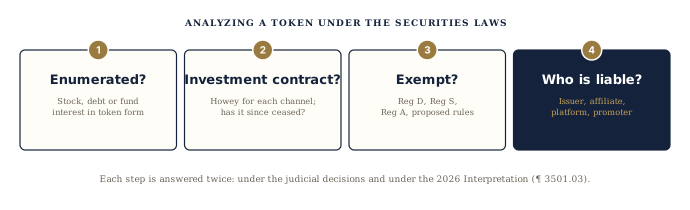
Two eras of authority. The authorities fall into two periods. From 2017 to the end of 2024 the Commission proceeded mainly by enforcement action, and the courts decided the meaning of Howey for tokens case by case. Those decisions remain binding or persuasive precedent, and the principles they state govern private litigation regardless of the Commission's current policy. From January 2025 the Commission formed a Crypto Task Force, dismissed its pending actions against the largest trading platforms, issued a series of staff statements, and in March 2026 adopted with the CFTC a formal interpretation of the definition of "security" as applied to crypto assets. Application of the Federal Securities Laws to Certain Types of Crypto Assets and Certain Transactions Involving Crypto Assets, Securities Act Release No. 33-11412, 91 Fed. Reg. 13714 (Mar. 23, 2026) (the "2026 Interpretation"). In August 2026 the Commission proposed a tailored offering regime and a safe harbor. Regulation Crypto Assets, Securities Act Release No. 33-11434, 91 Fed. Reg. 54510 (proposed Aug. 21, 2026). The practitioner must apply both bodies of authority at once: the judicial decisions for what the law is, and the Commission's interpretation for how the Commission will administer it.
The limits of the 2026 Interpretation. The 2026 Interpretation states that it "does not supersede or replace the Howey test, which is binding legal precedent," and describes itself as the Commission's views on how aspects of Howey apply to crypto assets. 91 Fed. Reg. at 13716. It binds the Commission and its staff in the administration of the securities laws, including enforcement. It does not bind the federal courts, private plaintiffs suing under section 12(a)(1), or state securities administrators. A future Commission may withdraw or revise it. Planning that depends on the Commission's view should therefore also be tested against the case law in ¶¶ 3510 to 3550 infra.
Terminology. This chapter uses the vocabulary of the 2026 Interpretation where it is useful. A "crypto asset" is any digital representation of value recorded on a cryptographically secured distributed ledger. Id. at 13715 n.1. A "non-security crypto asset" is a crypto asset that is not itself a security. A "digital security" or "tokenized security" is a security represented on a distributed ledger, treated more fully in ch. 8. The term "token" is used for any crypto asset regardless of classification. "Issuer" means the person whose representations or promises are said to create an investment contract, which may be a company, a foundation or a development team. "Platform" means a centralized trading venue that holds customer assets and matches or fills orders.
Organization of the chapter. Section ¶ 3510 sets out the statutory definition and the Howey test. Sections ¶¶ 3520 to 3550 discuss the token cases in full, from the DAO Report to the secondary-market decisions of 2023 and 2024. Section ¶ 3560 describes the 2025 shift and the 2026 Interpretation. Section ¶ 3570 addresses offering exemptions and the proposed Regulation Crypto Assets. Section ¶ 3580 treats trading platforms and section 12(a)(1) liability. Section ¶ 3590 closes with an analysis sequence, drafting points and a checklist.