

¶ 2901
Overview
Scope of the chapter. Three problems recur in every insolvency of a platform that held digital assets for customers. The first is the date and method by which a claim measured in tokens becomes a claim measured in dollars. The second is whether the estate pays creditors in tokens or in cash, and by what mechanics. The third is whether the estate may recover from customers the tokens and stablecoins they withdrew shortly before the filing. This chapter treats each in turn. Chapter 27 sets out the framework that precedes all three: what is property of the estate, the characterization of customer assets, and the filing of claims. Chapter 28 recounts the histories of the major failures. This chapter draws on those histories only where a court has decided a question of valuation, distribution or avoidance, with cross-references for the facts. See infra ch. 27; ch. 28.
Why these questions arise together. The three problems share a cause. Token prices move sharply over the months or years that a case takes to resolve. A rule that fixes value on one date allocates the gain or loss from later movement to one group and away from another. If claims are fixed in dollars at the petition date and the estate later holds tokens worth more, the surplus goes to whoever the plan says receives it. If customers who withdrew in the ninety days before the filing must return the value of what they withdrew, the date at which that value is measured decides whether a defendant pays for a later rise in price. Each rule is a choice about who bears the market.
The statutory anchor. The Bankruptcy Code fixes the date for allowance of claims. When a party objects to a claim, the court "shall determine the amount of such claim in lawful currency of the United States as of the date of the filing of the petition." 11 U.S.C. § 502(b). The provision was written with claims for money in mind, including claims in foreign currency. Its application to claims for tokens follows from its terms: a claim for a quantity of bitcoin is converted into dollars at the petition date, whatever the later price. The bankruptcy courts in the two largest crypto cases have applied that rule. See ¶¶ 2910, 2920.
Recovery of avoided transfers. The rules for recovering an avoided transfer point in a different direction. Section 550(a) allows the trustee to recover "the property transferred, or, if the court so orders, the value of such property." 11 U.S.C. § 550(a). The section names no valuation date. In the Celsius customer preference actions, the court held in 2026 that the date depends on whether the transferred asset has risen or fallen in value and on whether the defendant still holds it. See ¶ 2960. The result is an asymmetry that counsel must understand: a customer's claim against the estate is fixed at petition-date prices, while the same customer's liability to return a preferential withdrawal may be measured by the asset itself or by a later price.
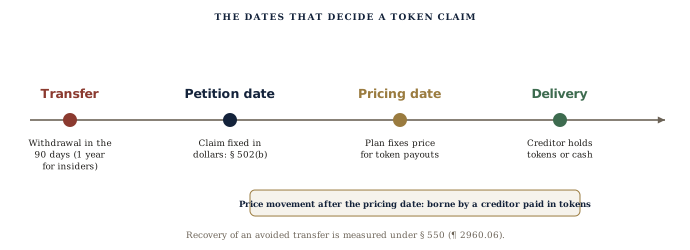
Distribution in kind. Nothing in the Code requires a plan to pay creditors in cash. Section 1123(a)(5)(D) lists among the means of implementing a plan "the distribution of all or any part of the property of the estate among those having an interest in such property of the estate." 11 U.S.C. § 1123(a)(5)(D). Plans in crypto cases have used both forms. The Celsius plan paid many creditors in bitcoin and ether through distribution agents. The FTX plan paid in cash. The Mt. Gox rehabilitation in Japan repaid in bitcoin and bitcoin cash. The choice between forms is a choice about who bears the price movement between the valuation date and the date of payment, and about the practical limits of distribution agents. See ¶ 2950.
Plan of the chapter. ¶ 2910 treats § 502(b) and the petition-date rule. ¶ 2920 treats the FTX estimation ruling of 2024 and the conversion rules of the Celsius plan, including the court's approval of the settlement value of the CEL token. ¶ 2930 treats claims for tokens that later appreciated, the special damages rule for swaps and repurchase agreements in § 562, and the judgment-currency cases that supply analogies. ¶ 2940 compares the treatment of token claims in Japan, England and Wales, Hong Kong and New Zealand. ¶ 2950 treats distributions in kind. ¶ 2960 treats preference actions against customers, including the Celsius rulings of 2025 and 2026. ¶ 2970 treats the safe harbor of § 546(e). ¶ 2980 treats fraudulent-transfer actions against insiders, investees and donees, and the litigation trusts that bring them. ¶ 2990 closes with a checklist.