
¶ 2301
Overview
Scope of the chapter. This chapter follows digital assets through the administration of a decedent's estate. It begins with the work of finding the assets and bringing them under the personal representative's control, continues with the decision whether to sell or hold them during administration, and then turns to the valuation questions that arise for the probate inventory, the federal estate tax return, the gift and generation-skipping transfer taxes, the basis of property acquired from a decedent and the estate's own income tax return. It closes with losses during administration, state death taxes and the distribution of digital assets in kind. Planning before death is the subject of ch. 21, and the mechanics of passing keys and recovery arrangements are the subject of ch. 22. This chapter assumes that the owner has died and that a personal representative has been, or is about to be, appointed.
Why digital assets change the administration. The law of estate administration was built around assets that announce themselves. A bank account generates statements, a brokerage account sends tax forms, land appears in the recorder's office and a stock certificate sits in a safe-deposit box. Digital assets held in self-custody announce nothing. The ledger records the asset under an address that carries no name, the private key that controls it may exist only in a device or a memorized phrase, and the decedent's family may know of the holding only through a remark at dinner. Digital assets held on an exchange are easier to find, because the exchange keeps an account in the decedent's name, but the account is subject to terms of service, to the exchange's procedures for deceased customers and to the exchange's own solvency. Ch. 13 describes the access rules of the Revised Uniform Fiduciary Access to Digital Assets Act, and ch. 10 describes the legal character of the customer's claim against a custodian.
The personal representative's duties. The uniform probate code makes the personal representative a fiduciary who must observe the standards of care applicable to trustees. The Arizona enactment, which is used throughout this chapter as the model text, provides that "a personal representative is a fiduciary who shall observe the standards of care applicable to trustees" and that the personal representative "is under a duty to settle and distribute the estate of the decedent ... as expeditiously and efficiently as is consistent with the best interests of the estate." Ariz. Rev. Stat. § 14-3703(A). Every personal representative "has a right to, and shall take possession or control of, the decedent's property" and must "take all steps reasonably necessary for the management, protection and preservation of" the estate in its possession. Id. § 14-3709(A). Those duties apply to tokens in the same terms as to any other property. What changes is the content of the steps that are reasonably necessary, which for a self-custodied asset may include forensic recovery of a key and the immediate transfer of the asset to a wallet the estate controls.
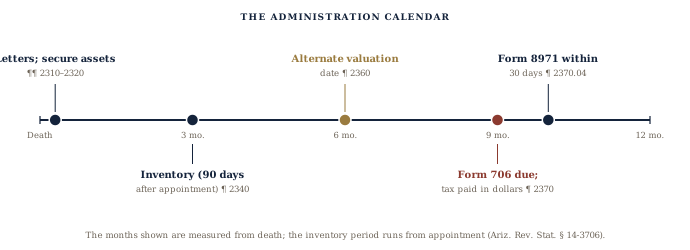
The tax framework. For federal estate tax purposes, digital assets are property. The gross estate includes "all property to the extent of the interest therein of the decedent at the time of his death," I.R.C. § 2033, valued at fair market value on the date of death or, if the executor so elects, on the alternate valuation date. Id. §§ 2031, 2032. The Instructions for Form 706 now direct that digital assets be reported on Schedule F and define them as "any digital representations of value that are recorded on a cryptographically secured distributed ledger or any similar technology," including nonfungible tokens, cryptocurrencies and stablecoins. Instructions for Form 706, at 32 (Rev. July 2026). The same instructions state that payment of the tax must be made in United States dollars and that "[d]igital assets are not accepted." Id. at 12. An estate whose principal asset is a token must therefore convert enough of it to pay the tax, which links the tax computation to the investment decision discussed in ¶ 2330.
Amounts for 2026. For decedents dying in 2026, the basic exclusion amount is $15,000,000. I.R.C. § 2010(c)(3)(A), as amended by Pub. L. No. 119-21, § 70106(a), 139 Stat. 162 (2025). The amount is indexed for inflation for decedents dying after 2026. Id. § 2010(c)(3)(B). The generation-skipping transfer tax exemption equals the basic exclusion amount. Id. § 2631(c). The gift tax annual exclusion is $19,000 per donee for 2026. Rev. Proc. 2025-32. The top marginal rate in the estate tax rate schedule is 40 percent. I.R.C. § 2001(c). An estate tax return is required where the gross estate exceeds the basic exclusion amount, id. § 6018(a)(1), and is due nine months after death, id. § 6075(a). The figures are collected in Table 23-3 at ¶ 2370.
The absence of decided cases. The searches made for this chapter found no reported decision of a United States court that values a digital asset for federal estate tax purposes, and none that surcharges a personal representative for the handling of a decedent's cryptocurrency. The analysis therefore proceeds from the statutes and regulations that govern all property, from the Internal Revenue Service's published guidance on digital assets and from the decided cases on concentrated and volatile holdings in other asset classes. The leading such case for a personal representative is In re Estate of Janes, 90 N.Y.2d 41 (1997), discussed in ¶ 2330.
Order of the chapter. Section ¶ 2310 treats locating and marshaling the assets. Section ¶ 2320 treats securing them on appointment. Section ¶ 2330 treats the duty to sell or hold. Section ¶ 2340 treats the probate inventory and the form of administration. Sections ¶¶ 2350 and 2360 treat federal estate tax valuation. Section ¶ 2370 treats gift and generation-skipping transfer tax, basis, income in respect of a decedent and the fiduciary income tax return. Section ¶ 2380 treats lost keys, losses during administration and state death taxes. Section ¶ 2390 treats closing the estate and distributing in kind, and ends with a checklist.