

¶ 2101
Overview
Scope of the chapter. This chapter examines the legal instruments by which an owner of digital assets provides for their transfer at death and for their management during incapacity. It covers the inventory that the plan rests on, the separation of instructions from the secrets that control the assets, the will and its specific bequests, the powers of the personal representative, the revocable trust and other nonprobate transfers, powers of attorney and guardianship, the rights of spouses, minors and beneficiaries under disability, charitable gifts, and estates that cross borders. It closes with a review cycle, model provisions and a checklist. The technical arrangements by which keys pass to successors are examined in ch. 22, and valuation and transfer taxes in ch. 23. This chapter concentrates on the documents a lawyer drafts and on the rules of succession law those documents must satisfy.
Why digital assets need separate planning. The ordinary estate plan assumes that the law can move property after death without the decedent's cooperation. A court can order a bank to pay a personal representative, a transfer agent can reregister shares on proof of death, and a recorder can accept a deed signed by an executor. Those assumptions hold for a digital asset held in a hosted account at an exchange or custodian, which can be reached through the custodian on proof of authority. See ch. 13. They fail for an asset held in self-custody, where the ledger recognizes only the holder of the private key and no institution stands between the decedent and the asset. See chs. 2 and 9. A will may give a self-custodied token to a named devisee, and a court may confirm the gift, but neither the will nor the order moves the token. The devisee receives it only if someone can produce the key. Planning for digital assets is therefore planning for two things at once: the legal title, which the ordinary instruments transfer, and the practical means of control, which they do not.
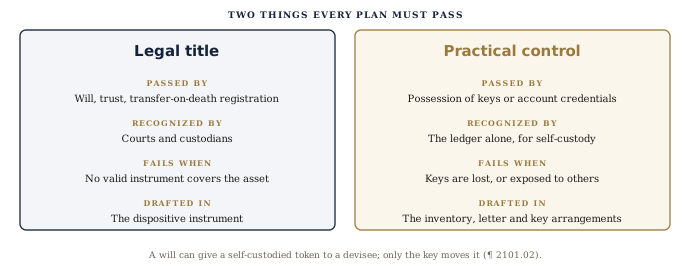
The two failure modes. Plans for digital assets fail in two opposite ways. The first is loss. The owner keeps the key so securely that no one else can find or use it, and the asset becomes unrecoverable on death or incapacity. The second is exposure. The owner records the key in a document that others will read, such as a will filed with a probate court, a letter left with a lawyer or a note on a shared computer, and the asset is stolen before or after death. The law of wills makes the second failure easy to commit, because a will becomes a public record on probate in most American jurisdictions. A plan for digital assets must therefore give the fiduciary enough information to find and control the assets while keeping the means of control out of every document that may be filed, copied or read by persons without authority. ¶ 2120 infra develops the techniques.
The legal framework. No single statute governs the succession of digital assets. The governing rules come from five sources. The first is the law of wills and intestacy, which determines who takes the decedent's property and how a will is executed and construed. This chapter uses the Florida Probate Code and the Michigan Estates and Protected Individuals Code as illustrative enactments, because both follow the Uniform Probate Code on most points and their texts are verified for this edition. The second is the law of nonprobate transfers: revocable trusts, beneficiary designations and transfer-on-death registrations. The third is the law of fiduciary access, chiefly the Revised Uniform Fiduciary Access to Digital Assets Act, examined in ch. 13. The fourth is the law of agency and guardianship, which governs management during incapacity. The fifth is the contract between the owner and any custodian, whose terms of service may permit or forbid transfer on death and will determine what the custodian requires before it releases an account.
Property status and the plan. The planning techniques in this chapter assume that a digital asset is property capable of passing by will or intestacy. American courts and statutes treat it so. See ch. 3. The treatment matters for planning in three respects. A token owned at death is part of the probate estate unless a nonprobate transfer moves it. A token owned during marriage may be community or marital property subject to a spouse's rights. See ¶ 2170 infra. And a token held for the owner by a custodian may be property of the owner or a contractual claim against the custodian, depending on the terms of the account. See ch. 10. The planner should identify, for each holding, which of those characterizations applies, because the answer determines which instrument controls the asset's succession.
Organization. ¶ 2110 treats the inventory and the information it should and should not contain. ¶ 2120 treats letters of instruction, separate writings and the risk that an informal electronic note will be admitted as a will, with a discussion of In re Horton. ¶ 2130 treats specific bequests of tokens and the doctrines of ademption and abatement as they apply to forks, swaps and volatile values. ¶ 2140 treats the personal representative's powers and duties, with a discussion of the Kleiman litigation over undocumented holdings. ¶ 2150 treats revocable trusts and nonprobate transfers. ¶ 2160 treats incapacity. ¶ 2170 treats spouses, minors and beneficiaries under disability. ¶ 2180 treats charitable gifts and cross-border estates. ¶ 2190 sets out a review cycle, model provisions and a checklist.