

¶ 1801
Overview
Scope of the chapter. This chapter examines the vehicles that hold digital assets without an owner in the ordinary sense: the civil-law foundation, the common-law foundation statutes modeled on it, the Cayman Islands foundation company, and the non-charitable purpose trust in its several offshore forms. These vehicles hold protocol treasuries, receive the proceeds of token sales, own the copyrights and trademarks associated with open-source software, fund development by grant, and in some structures issue the tokens themselves. The chapter explains why the ownerless form is chosen, describes the principal statutes, examines how such a vehicle is governed when the community it serves holds tokens and no shares, and addresses the control of keys, tax classification, creditor claims and insolvency. It closes with a comparison of the foundation, the purpose trust and the decentralized autonomous organization limited liability company, and with a checklist.
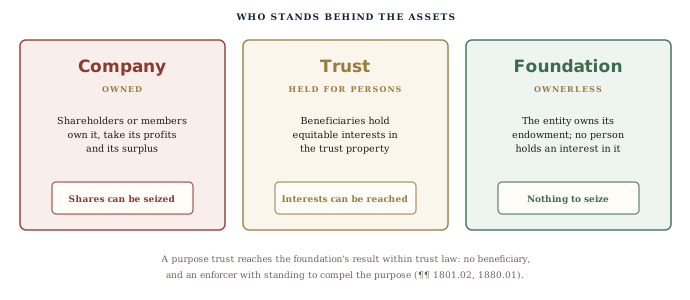
What “ownerless” means. A company has shareholders or members who own it, receive its profits and, on winding up, its surplus. A trust has beneficiaries who hold equitable interests in its property. A foundation, by contrast, owns its own assets and has no owner. It is a legal person whose endowment is dedicated to purposes stated in its charter, administered by a council or board whose duties run to the foundation itself. A purpose trust achieves a similar result within the law of trusts: the trustee holds property for a purpose and no beneficiary has an enforceable interest, so that the duty to carry out the purpose is enforced by a designated enforcer. In each case there is no person whose interest in the vehicle is property that can be sold, inherited or seized. For digital-asset projects that wish to show that no promoter owns the treasury, or that wish to hold assets for a network that no one controls, the ownerless form offers a legal expression of that design.
Relationship to other chapters. The foundation and purpose trust are treated in this chapter as holding and administrative vehicles. Their use in asset protection planning for individuals is treated more fully in Lighthouse on Asset Protection, which discusses the creditor provisions of the Nevis, Cook Islands, Belize, Liechtenstein, Panama, Jersey, Guernsey and Wyoming foundation statutes in detail. The unincorporated decentralized autonomous organization and the risk that its token holders will be treated as partners are examined in ch. 19, and the statutory DAO limited liability company in ch. 20. Custody models and the legal meaning of control are examined in chs. 9 and 10, international tax reporting in ch. 32, and voidable transfers in ch. 26. The regulatory treatment of token issuance is reserved to Part XI, in particular ch. 35 (United States securities law), ch. 38 (the European Union) and ch. 39 (the Gulf and the offshore centers).
Three questions. For each vehicle the practitioner should ask three questions. First, who controls the assets in law and in fact, and is that control consistent with the representations made to token holders and regulators? Second, what rights, if any, do token holders, grant recipients or other members of the community have against the vehicle and its officers, and by what means are those rights enforced? Third, how will courts and authorities outside the vehicle's home jurisdiction treat it: as a juridical person, as a trust, as the alter ego of its founders, or as a participant in a securities offering? The answers often depend more on the facts of governance than on the statute. A foundation whose council follows the instructions of the developers who formed it will be treated by a foreign court as an instrument of those developers, whatever its charter says (see infra ¶ 1850).
Terminology. This chapter uses founder for the person who establishes a foundation and endowment for the property contributed to it. Council refers to the governing body of a foundation, however named (Stiftungsrat in Switzerland and Liechtenstein, foundation council in Panama and Jersey, board of directors in Wyoming and in a Cayman foundation company). Guardian, supervisor, protector and enforcer refer to persons who oversee the council or enforce the purposes; the statutes assign these offices different names and powers, which are compared in Table 18-2. Treasury means the digital assets and fiat reserves that a vehicle holds to fund a network or project. Token holder means a person who holds the tokens of the network the vehicle serves, whether or not the person has any legal relationship with the vehicle.
Organization of the chapter. Paragraph 1810 explains why ownerless structures are used. Paragraph 1820 addresses the Cayman Islands foundation company and STAR trust. Paragraph 1830 addresses the Swiss and Liechtenstein foundations and Liechtenstein's token statute. Paragraph 1840 addresses Panama, Nevis, the British Virgin Islands, Jersey, the protective foundation statutes and the Wyoming statutory foundation. Paragraph 1850 addresses governance and the legal effect of token-holder voting. Paragraph 1860 addresses the treasury: keys, custody and distributions. Paragraph 1870 addresses tax classification, reporting and contacts with the United States. Paragraph 1880 addresses creditors, insolvency and the courts, and ¶ 1890 sets out the considerations for choosing among the vehicles and a checklist.