

¶ 1501
Overview
Scope of the chapter. Chapter 14 states the duties a trustee owes when the trust holds digital assets. This chapter turns from duty to design. It examines how a trust instrument can be drafted so that digital assets are held, managed and passed on in a way that the law will respect and that the trustee can perform. The central device is the directed trust, in which the instrument assigns investment, custody or other functions to a person other than the trustee and limits the trustee's responsibility for the way those functions are exercised. The chapter examines the Uniform Directed Trust Act and the directed-trust statutes of Delaware, South Dakota, Nevada, Wyoming and New Hampshire; the duties and liability of the trust director and of the directed trustee; the reported decisions; and the provisions an instrument needs when its assets are tokens: retention and anti-diversification clauses, express powers to stake, lend, vote and deal with forks and airdrops, key-management and key-succession provisions, valuation and accounting provisions, and the use of a limited liability company beneath the trust. It closes with situs, the revocable trust as a probate substitute for tokens, offshore trusts, and a drafting checklist.
Why design matters more for digital assets. Most trust instruments in use today were drafted for a portfolio of marketable securities held by a bank or broker. The trustee or its custodian holds the assets in an account, the assets have a reliable market price, and the trustee's prudence is measured against a familiar body of investment practice. Digital assets depart from that model at each point. Control depends on knowledge of key material and is lost if the key material is lost (see supra ch. 2, ¶ 230). Prices are volatile, and many tokens have no reliable market. A trustee that has never held a token may lack the operational ability to receive one, and an institutional trustee may decline to hold certain tokens at all. The default rules of trust law, which require the trustee to take control of trust property, to protect it and to diversify, can place a trustee in an impossible position if the instrument does not address these facts (see supra ch. 14). A well-drafted instrument resolves the tension in advance. It allocates each function to the person best placed to perform it, states the standard by which each person will be judged, and gives the trustee the powers the assets require.
The directed trust as the principal tool. A directed trust divides the functions of trusteeship. One person, usually an institutional or professional trustee, holds legal title and performs administrative functions. Another person, called a trust director, investment adviser, trust advisor or trust protector depending on the statute, holds a power to direct the trustee with respect to investments, distributions or other matters. Statutes in every state that has developed a modern trust industry validate the arrangement and relieve the directed trustee of liability for following directions, subject to a minimum standard. For digital assets, the directed trust allows a settlor to place the investment and custody decisions with a person who understands the assets while the trustee provides the regulated, administrative and situs functions that make the trust work. The arrangement does not remove fiduciary responsibility. It relocates responsibility to the trust director, and the statutes make the director a fiduciary unless the instrument provides otherwise (¶ 1530).
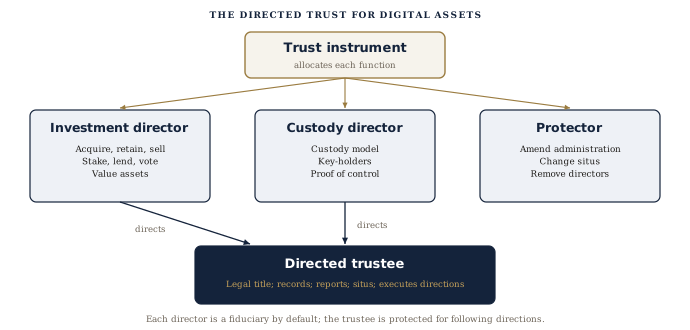
What the instrument must address. A trust that will hold digital assets should address at least the following matters in its terms: who decides what to buy, hold and sell; who selects the custodian and the custody model; who holds key material, under what controls, and who succeeds to it; whether the trustee must diversify; whether the trustee or director may stake, lend, vote governance tokens, claim airdrops and elect on forks; how assets without a reliable market are valued and reported; whether assets are held directly or through an entity; and which state's law governs and where the trust is administered. Each matter is examined in this chapter. The model provisions collected in ¶¶ 1550 to 1590 are drafted to be adapted, and each is accompanied by notes on the choices it makes.
Relation to other chapters. Custody models are described in ch. 9, the private-law character of a custodial account in ch. 10, and the institutions that may serve as custodians in ch. 11. Fiduciary access to online accounts under the Revised Uniform Fiduciary Access to Digital Assets Act is examined in ch. 13. The trustee's duties of prudence, diversification and security are the subject of ch. 14, and fiduciary liability and exculpation of ch. 16. Holding digital assets through a limited liability company is examined in ch. 17, estate planning in ch. 21, and key succession in ch. 22. This chapter cross-refers to those chapters and does not repeat them.
Terminology. The statutes use different names for the person who directs the trustee. The Uniform Directed Trust Act uses "trust director." Delaware uses "adviser" and treats a "protector" as a kind of adviser. South Dakota, Nevada and Wyoming use "trust advisor" or "trust adviser" for persons with investment or distribution powers and "trust protector" for persons with other powers. New Hampshire uses "trust advisor" and "trust protector" interchangeably for any non-trustee power holder. This chapter uses "trust director" as the general term and the statutory term when discussing a particular statute. It uses "directed trustee" for a trustee that is subject to a director's power, and "excluded fiduciary" when a statute uses that term. A "digital asset adviser" is used informally for a trust director whose powers extend to the investment and custody of digital assets.
A note on statutory text. Directed-trust statutes are amended often. The provisions quoted in this chapter were read in the official compilations of each state as of November 2026. A drafter should confirm the current text, the effective-date provisions and any transition rules before relying on a statute for a particular trust.