

¶ 3101
Overview
Scope of the chapter. Many of the largest trusts are funded with a single asset: the founder's shares in the company that made the family's fortune, a block of stock received on the sale of that company, or a controlling interest in a private business that the family intends to keep. Trust law's default rules point the other way. A trustee must ordinarily diversify, and a trustee who holds a concentrated position too long may be surcharged for the loss. This chapter examines how a settlor who wants the trust to keep a concentrated position can achieve that result and how a trustee who is asked to keep it can be protected. It covers the duty to diversify and the exception for special circumstances; retention clauses and the way courts have read them; the Delaware statutes on retention, advisers and excluded cotrustees; the comparable rules in other American jurisdictions; the British Virgin Islands' Virgin Islands Special Trusts Act, which was written for this problem; the reserved-power and investment provisions of Cayman, Jersey, Nevis and Belize; the tax rules that govern hedging or monetizing a concentrated position inside a trust; the governance of a special holding once the trust is set up; and drafting.
The problem stated. The duty to diversify rests on a simple proposition about risk. Owning one stock exposes the owner to the misfortunes of one company, and nobody pays the owner for bearing that risk, because it could have been eliminated at little cost by owning more stocks. The official comment to the Uniform Prudent Investor Act calls this "uncompensated risk" and states that "[t]he object of diversification is to minimize this uncompensated risk of having too few investments." Unif. Prudent Investor Act § 3 cmt. (1994). A founder who has built a company sees the same holding differently. To the founder the shares are a source of control, of family identity and of continuing employment for relatives, and the founder may have reasons to believe the company will outperform any diversified portfolio. The law resolves the conflict by allowing the settlor to choose. The prudent investor rule is a default rule that "may be expanded, restricted, eliminated, or otherwise altered by the provisions of a trust." Id. § 1(b). The difficulty lies in saying so clearly enough, and in arranging the trust so that the trustee who follows the instruction is protected.
Three techniques. The instruments and statutes examined in this chapter use three techniques, often together. The first is a direction or authorization to retain, combined with language relieving the trustee of the duty to diversify and of liability for retention. The second is to take the investment decision away from the trustee and give it to another person: an investment adviser or trust director whose direction the trustee must follow (see supra chs. 6–10), or a cotrustee with exclusive authority over the holding. The third, which the British Virgin Islands developed, is a statutory regime under which the trustee holds the shares on trust to retain them, has no duty to supervise the company's management and may intervene only on defined complaints. Each technique moves the risk of the concentrated position from the trustee to the beneficiaries, who bear it because the settlor chose it for them.
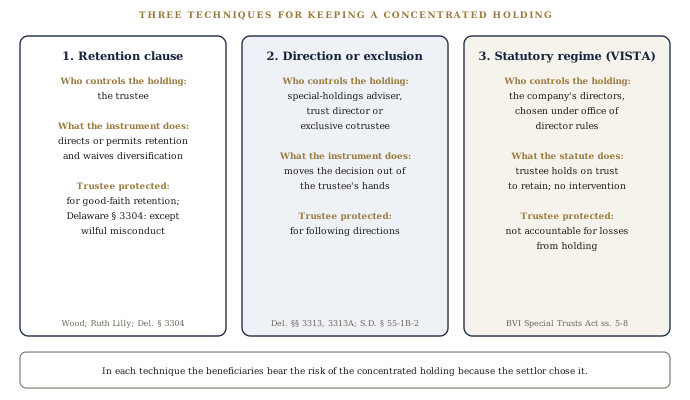
Who bears the risk. That allocation is the core of the subject. A beneficiary of an undiversified trust may receive far less than the beneficiary of a diversified trust of the same initial size. The instruments in this chapter are effective because the law respects the settlor's freedom to impose that outcome. They are drafted well when the beneficiaries and the trustee can see, from the instrument, that the settlor made the choice deliberately and when the instrument says who decides whether the holding should eventually be sold.
Relation to other chapters. The trust's ownership of the business through entities is treated in chapter 30 and the succession of a closely held business in chapter 32. The investment adviser and special-holdings adviser are treated in chapter 8, the directed-trust statutes in chapters 6 and 7, and the liability of directed trustees in chapter 10. Purpose trusts, which hold the shares in some offshore structures, are treated in chapter 27, and private trust companies, which often serve as trustee of a family's concentrated holding, in chapter 28. In re Estate of Janes, the leading American decision surcharging a trustee for holding a concentrated position, is discussed in chapter 1 (see supra ch. 1).