

¶ 2901
Overview
Scope of the chapter. The earlier chapters of this book treat the trust as a legal structure: a set of offices, powers and duties that the instrument creates and the courts enforce. A trust meant to last for generations also needs something the instrument cannot supply by itself, which is a family able to fill those offices, to agree on how the powers should be used and to settle its disagreements without destroying the property the trust holds. This chapter examines the arrangements families use for that purpose and the points at which they meet the law. It covers the reasons governance matters for long-lived trusts; family constitutions and charters, and whether they bind anyone; family councils and assemblies; the ways a trust instrument can connect those bodies to the offices of trustee, protector, adviser and trust director; education of the next generation; the resolution of disputes inside the family; the single-family office and its exclusion from the Investment Advisers Act of 1940; the deduction of family office costs after Lender Management, LLC v. Commissioner; conflicts between the family office and the trustees; and drafting.
Terminology. The vocabulary of family governance is not a legal vocabulary, and the same word means different things in different families. The chapter uses the following terms. A family constitution (sometimes called a charter, protocol or statement of family values) is a written document, adopted by the members of a family, that sets out the family's shared purposes and the rules by which it will make collective decisions about its wealth and its businesses. A family assembly is the meeting of all adult members of the family, usually held once a year. A family council is a smaller body chosen by or on behalf of the family to act for it between assemblies. A family office is an organization that manages the investments and personal affairs of a single family; a multifamily office serves more than one. Each of these may or may not hold a legal office in a trust; when it does, its powers and duties come from the trust instrument and the law of the trust's jurisdiction, and the family's own documents cannot enlarge or reduce them.
The two systems. A family with a substantial dynasty trust lives under two systems at once. The first is legal: the trust instrument, the governing law, the fiduciary duties of the trustee and the other office holders, and the jurisdiction of the court. The second is social: the family's customs, its meetings and documents, its expectations of one another, and the informal authority of its senior members. The legal system is enforceable but narrow. A court can compel a trustee to account, to administer the trust according to its terms and to act in good faith, but it cannot make two branches of a family speak to one another. The social system is broad but unenforceable. It can produce consensus about how a business should be run or how much each generation should take out of the trust, but it cannot compel anyone to honor that consensus. The design problem this chapter addresses is how to connect the two so that each supports the other: so that the family's governance bodies have a recognized role in the trust's administration, and so that the trust's legal machinery is used in a way the family regards as legitimate.
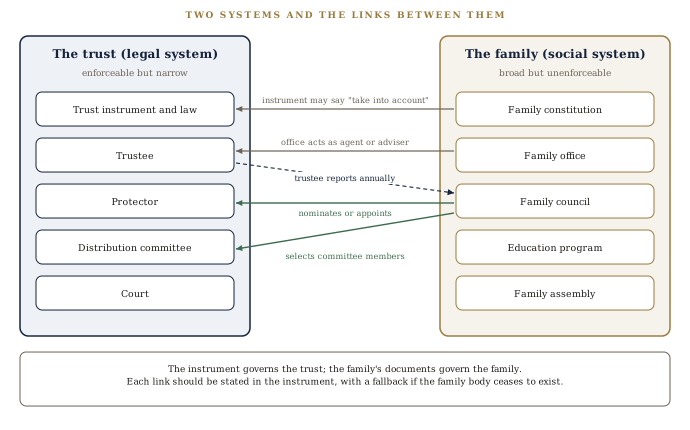
Plan of the chapter. Paragraph 2910 explains why governance matters more for trusts of long duration. Paragraphs 2920 through 2950 examine the family's own institutions: the constitution, the council and assembly, the links between those bodies and the trust offices, and education. Paragraph 2960 considers disputes. Paragraphs 2970 and 2980 turn to the family office, first its form and its regulation under the federal securities laws, then its costs, the tax treatment of those costs and the conflicts it creates. Paragraph 2990 collects the drafting points and offers model provisions.