
¶ 4401
Overview
Scope of the chapter. An LLC classified as a partnership pays no federal income tax, but it is examined, assessed and, in the ordinary case, made to pay as if it did. Since 2018 every partnership return has been subject to the centralized partnership audit regime enacted by the Bipartisan Budget Act of 2015, Pub. L. No. 114-74, § 1101, 129 Stat. 584, 625–38, and codified at I.R.C. §§ 6221 through 6241. Under that regime, adjustments to partnership-related items are determined at the partnership level, and the tax attributable to them is assessed against and collected from the partnership in the year the audit ends, unless the partnership elects out of the regime in advance or pushes the adjustments out to the persons who were its partners in the year under audit. I.R.C. §§ 6221(a), 6225(a), 6226(a). This chapter examines the regime as it applies to LLCs: its history, its scope and the election out, the partnership representative, consistency and administrative adjustment requests, the computation and modification of the imputed underpayment, the push-out election, the procedure from notice to judicial review, and the allocation of the economic burden among current and former members. It closes with state conformity, the current enforcement climate, model operating agreement provisions and a checklist.
Why the regime matters to LLC law. The regime is federal procedure, but its consequences fall on matters that the operating agreement governs. It requires the LLC to name a single person with sole authority to bind the company and every member in dealings with the Internal Revenue Service. The regulations add that the person's failure to follow the operating agreement has no effect on that authority. Treas. Reg. § 301.6223-2(d)(1). It imposes an entity-level liability whose economic cost falls on the persons who are members when the bill is paid, who may differ from the persons who received the income. It creates elections, deadlines and information demands that require cooperation from members who may have left the company years earlier. Each of these points requires a drafting decision, and an operating agreement written before 2018, or one that still speaks of a "tax matters partner," usually makes none of them. Chapter 19 examines the governance of officers and boards, and Chapter 23 examines indemnification; this chapter draws on both where the partnership representative is concerned.
Terms used in this chapter. The statute and regulations use a vocabulary of their own. The reviewed year is the partnership taxable year to which the item being adjusted relates. I.R.C. § 6225(d)(1). The adjustment year is the year in which the decision of a court becomes final, an administrative adjustment request is made or, in other cases, the notice of final partnership adjustment is mailed. Id. § 6225(d)(2). A reviewed year partner is any person who held an interest in the partnership at any time during the reviewed year, and an adjustment year partner is any person who held an interest at any time during the adjustment year. Treas. Reg. § 301.6241-1(a)(2), (9). A partnership-related item is any item or amount with respect to the partnership that is relevant in determining any person's income tax liability, including any item relating to a transaction with, basis in or liability of the partnership, and any partner's distributive share of such an item. I.R.C. § 6241(2)(B). The imputed underpayment is the amount the partnership owes under section 6225. A pass-through partner is a partnership, an S corporation, a trust other than a wholly owned grantor trust, or a decedent's estate that holds an interest in the partnership, and an indirect partner is a person who holds its interest through one or more pass-through partners or through a disregarded entity. Treas. Reg. § 301.6241-1(a)(4), (5). The chapter uses "partnership" when describing the statute and "LLC" when describing its application, and treats a member of an LLC classified as a partnership as a partner for these purposes.
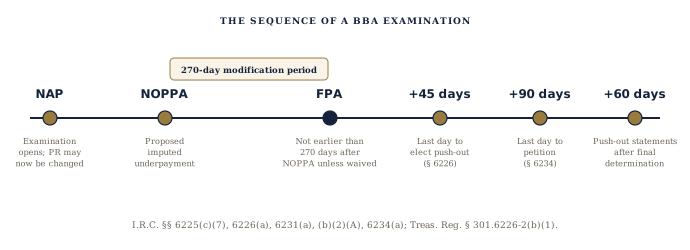
The sequence of an examination. The procedure has a fixed order, which later sections follow. The IRS mails a notice of administrative proceeding (NAP) to the partnership and its partnership representative, then a notice of proposed partnership adjustment (NOPPA), and finally a notice of final partnership adjustment (FPA). I.R.C. § 6231(a). The NOPPA opens a 270-day period in which the partnership may ask that the imputed underpayment be modified. Id. § 6225(c)(7). The FPA may not be mailed earlier than 270 days after the NOPPA unless the partnership waives the period. Id. § 6231(b)(2)(A). Within 45 days after the FPA the partnership may elect to push the adjustments out to its reviewed year partners, and within 90 days it may petition for readjustment. Id. §§ 6226(a)(1), 6234(a). Figure 44.1 sets out the sequence.