
¶ 2801
Overview
Scope of the chapter. This chapter tells the history of the principal failures of digital-asset exchanges, custodians and lenders, from the collapse of Mt. Gox in 2014 to the distributions in the FTX cases in 2026. For each failure it describes what happened, the proceedings that followed, the rulings that decided whether customers owned their assets or held claims, the way the estate was distributed, and the lessons the record offers to those who draft custody terms, lend to platforms, or hold digital assets as fiduciaries. The doctrinal framework of property of the estate, customer claims and the automatic stay is set out in ch. 27. The valuation of claims under § 502(b), distributions in kind and avoidance actions against customers are examined in ch. 29. This chapter supplies the facts against which those rules have been applied. It states the doctrine only so far as needed to explain what each court decided.
Sources. The account in this chapter is drawn from the opinions and orders of the courts that administered the proceedings, from reports filed with those courts by debtors, trustees and liquidators, from the published reports of regulators, and from press releases issued by the United States Department of Justice and by the estates. Facts about individuals are stated only as those sources state them. Where a fact rests on a secondary account, the text says so. Several of the proceedings are still open, and later events may change the figures given for recoveries.
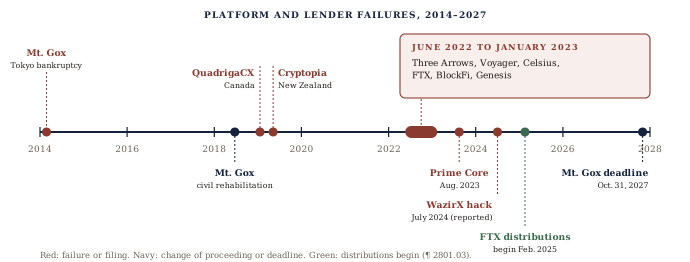
Three generations of failure. The failures fall into three groups. The first group consists of the early exchange failures: Mt. Gox in Japan (2014), QuadrigaCX in Canada (2019) and Cryptopia in New Zealand (2019). Each involved an exchange that held customer assets in wallets it controlled, lost a large part of them through theft or misappropriation, and was wound up under the insolvency law of its home jurisdiction. The second group consists of the failures of 2022, which followed one another within six months: Three Arrows Capital, Voyager, Celsius, FTX, BlockFi and Genesis. These failures were linked. The default of one borrower caused losses at its lenders, and the collapse of one exchange exposed the lenders that had dealt with it. The third group consists of later failures, including the Prime Core trust company in Nevada (2023) and the restructuring of an Indian exchange through a Singapore scheme of arrangement (2025). The later failures applied lessons from the earlier ones and also showed that a regulated charter does not of itself protect customer assets.
The recurring question. In almost every case the central legal question was the same: did the customer own the assets credited to its account, or did the customer hold a claim against the platform for their return? The answer decided whether the customer stood outside the estate, entitled to its assets in full, or shared pro rata with general creditors. The courts answered the question by reading the platform's terms of service, by examining whether the platform's records identified each customer's assets, and by asking whether the assets could be traced. The answers varied from program to program within a single platform. Celsius customers in its custody program were treated differently from customers in its interest-bearing program, and BlockFi customers holding wallet accounts were treated differently from those holding interest accounts. The general framework for this question is in ch. 10.
The second recurring question. The second recurring question was the date at which the value of a customer's claim was measured. A claim for tokens that had fallen in value between the petition date and the distribution date was worth less if measured in kind; a claim for tokens that had risen was worth more. Section 502(b) of the Bankruptcy Code directs that claims be determined in lawful currency of the United States as of the petition date. The FTX plan applied that rule. The Genesis plan made distributions in kind under a settlement among creditors. The Mt. Gox rehabilitation plan permitted repayment in bitcoin. The consequences of these choices for creditors were large. Each case history describes them. The doctrine is examined in ch. 29.
Plan of the chapter. Paragraph 2810 describes the early failures. Paragraph 2820 describes Three Arrows Capital and Voyager, the first of the 2022 failures. Paragraph 2830 describes Celsius, whose bankruptcy produced the most detailed judicial treatment of customer ownership. Paragraph 2840 describes BlockFi and the Genesis and Gemini Earn proceedings. Paragraphs 2850 and 2860 describe FTX: the collapse, the control failures disclosed in the debtors' reports, the Bahamian liquidation, the plan and its distributions, and the criminal case. Paragraph 2870 describes Prime Core and later failures. Paragraph 2880 compares the failures in tabular form. Paragraph 2890 states the lessons for counsel and closes with a checklist.